How To Configure Product Prices
Introduction
The Standard Enactor Retail Pricing Process may be configured by retailers for usage with Product Prices, Price Changes, and Price Groups. Retailers can create new pricing types and/or provide a price context in product prices for custom requirements.
The functionality of Product Price is a parameter-driven pricing search method that, given a product ID, returns a price for that product that is location specific or based on a price group. It is subject to effective-dated price changes and takes as inputs a given currency, a price type, and a price context.
Overview
This guide covers the configuration for the following:
- Product Prices - Configuring prices for a product, both in Price Groups and for individual Locations.
Prior Training / Experience
You should be familiar with the following:
- Estate Manager Configuration
- Data Broadcasting
- Product Configuration
Configuration Steps
Configuring Prices via Product Maintenance
Product prices can be configured directly from within the Product Maintenance application.
Navigate to Product Maintenance using the Search or the path:
Main Menu > Configuration > Merchandise > Products
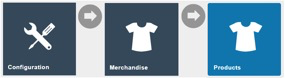
The Product Maintenance application lists all configured products.
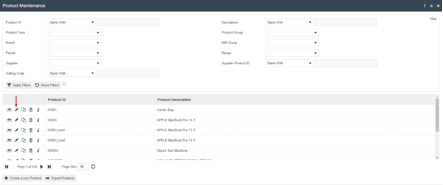
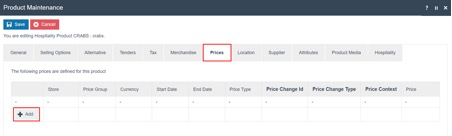
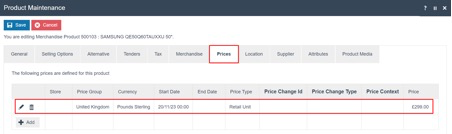
Click the Edit icon on the product to be priced, then select the Prices tab. Prices for the product - both in Price Groups and for individual Locations - are listed in the Prices tab.

The + Add option on the Prices tab provides direct access to the Create a new Product Price option of the Product Price Maintenance page. This is the same form described in the following section.
The Product Price may be defined in association with a Price Group or a specific Location (but not both). Following creation of the new price, selecting Save will save the entry. Selecting Cancel returns the user to the Product Maintenance page.
Select a Price Group and click Create.
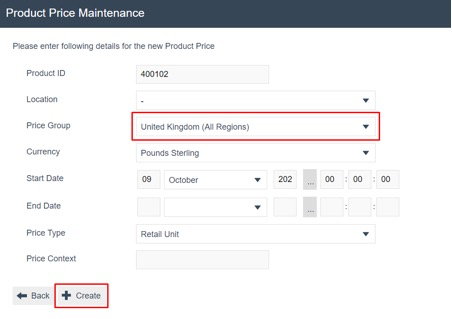
Enter a Price and click Save.

The price is added to the product and displayed in the Prices tab.
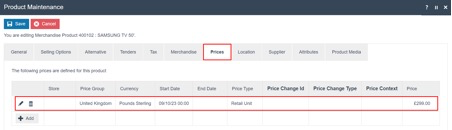
The product can be saved and the Product Price broadcast to the POS.
Product Prices may also be created or modified by directly accessing the Product Price Maintenance page from the Estate Manager menu, as described in the next section.
This completes the price configuration via Product Maintenance.
Configuring Product Prices
The Product Price configuration element defines one specific price for one specific product. A Product Price may be associated with a Price Group and will be applicable wherever both the Product and Price Group are applicable.
Creating a Product Price
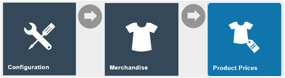
Navigate to Product Price Maintenance using the Search or the path:
Main Menu > Configuration > Merchandise > Product Prices
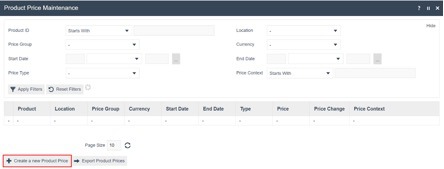
Select Create a new Product Price to create a Product Price.
This is the same form reached using the + Add option from the Prices tab of the Product Maintenance page, as described in the previous section.

Set the appropriate values as follows:
| No | Field | Description |
|---|---|---|
| 1 | Product ID | The ID of the Product to which the Product Price will apply. |
| 2 | Location | Drop-down list selection from all configured Locations. Not selectable if a Price Group is selected. |
| 3 | Price Group | Drop-down list selection from all configured Price Groups. Not selectable if a Location is selected. |
| 4 | Currency | Drop-down list selection of all configured Currencies. Each Product Price relates to a specific Currency. |
| 5 | Start Date | Start of the Effective Date period; the date after which the Product Price applies. |
| 6 | End Date | End of the Effective Date period; the date until which the Product Price applies. |
Click Create once the values have been entered.
A Product Price can apply only to a Price Group or a Location, not both. If both Location and Price Group are specified, the following error is displayed when Save is selected: "Location and Price Group cannot be set at the same time."
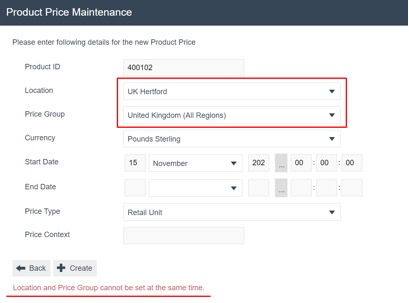
This completes the new Product Price creation.
Product Price - General Tab
In the General tab, specify values that qualify the applicability of the Product Price.

| Field | Description |
|---|---|
| Price | A positive numeric value specifying the price for the product. |
| Price Change | Drop-down list selection of defined Price Changes. A Product Price may be associated with a Price Change, which may be associated with other products (e.g. a Seasonal Price Change for a range of products). A Price Change is independently subject to effective dating. |
| Disallow Promotions | Checkbox. If checked, promotions are disallowed with this price. |
| Disallow Discounts | Checkbox. If checked, discounts are disallowed with this price. |

Click Save to apply the changes.
When a single product has multiple active prices:
- If all prices belong to the same Price Group, the POS uses the price with the most recent current start date. Prices with future start dates are disregarded.
- If all prices belong to the same Location, the POS uses the price with the most recent current start date. Prices with future start dates are disregarded.
- If a mixture of Location Prices and Price Group Prices are configured, the Location price with the most recent current start date takes precedence. Prices with future start dates are disregarded.
This completes the Product Price General tab configuration.
Price by Measurements
Products sold by weight, liquid measure, or length can be priced based on measurements. In the Product Maintenance application, navigate to the Merchandise - General sub-tab and set the Measure System and Sales Units fields to configure the product for Price by Measurement.

| Field | Description |
|---|---|
| Measure System | Selected from a drop-down list of all configured Measure Systems. Associates the product with a specific Measure System. |
| Sales Units | Selected from a drop-down list of all units defined for the selected Measure System. Identifies the specific unit of measure for sales. |
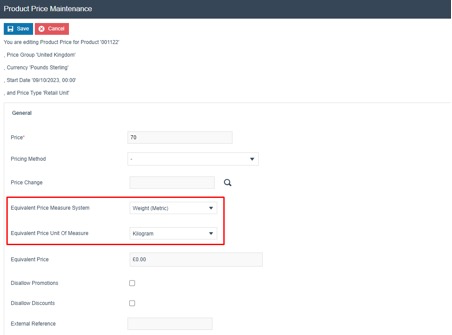
Navigate to the Prices tab and click + Add to configure a price for the product.
| Field | Description |
|---|---|
| Price | The specified price for the product. |
| Equivalent Price Measure System | Drop-down list of configured Measure Systems. Select the Measure System the product will be priced by. |
| Equivalent Price Unit of Measure | Drop-down list of units defined for the selected Measure System. Identifies the unit of measure for the price. |
| Equivalent Price | The price of the equivalent unit of measure selected above. |
Click Save to apply the changes.
This completes the Price by Measurements configuration.
Pricing Method
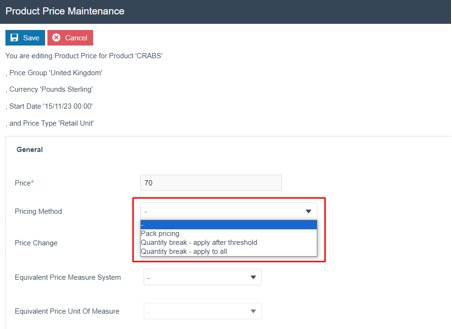
The Pricing Method allows the product price to be altered depending on the quantity purchased.
| Field | Description |
|---|---|
| Pricing Method | Available for Retail Unit Price Types. Options are: Pack Pricing, Quantity break - apply after threshold, or Quantity Break - apply to all. |
The three available Pricing Methods are described in the following sections.
Quantity Break - Apply to All
A Quantity Break pricing strategy reduces the unit price of an item as the customer purchases a larger quantity. With Quantity Break - Apply to All, the reduced price applies to all items in the transaction once the threshold quantity is reached - including items already purchased below the threshold.
For example: a product is priced at 2.99 per unit if a customer buys three or fewer; the price per unit decreases to 2.59 if they buy four or more (including the original three items).
Navigate to Product Maintenance and click the Edit icon of a product. Select the Prices tab and click + Add.
From the Pricing Method drop-down, select Quantity break - apply to all. The Quantity Prices tab becomes available.

The Quantity Prices tab allows multiple quantity-based prices to be defined, each applying at a different quantity threshold. Create a list of threshold values by entering values and selecting + Add. Entries may be deleted using the associated Delete icon.
| Field | Description |
|---|---|
| Quantity | A quantity of items above which this price is applied according to the selected Pricing Method. |
| Price | The price per individual item to be applied according to the selected Pricing Method. |
Click Save to apply the changes.
This completes the Quantity Break - Apply to All configuration.
Quantity Break - Apply after Threshold
Quantity Break - Apply after Threshold reduces the product price only for items sold above the specified threshold. Items sold at or below the threshold retain the original price.
For example: the first three items are priced at 2.99 each; any subsequent items up to the seventh are priced at 2.59; and items beyond that are priced at 2.35.
Navigate to Product Maintenance and click the Edit icon of a product. Select the Prices tab and click + Add.
From the Pricing Method drop-down, select Quantity break - apply after threshold. The Quantity Prices tab becomes available.
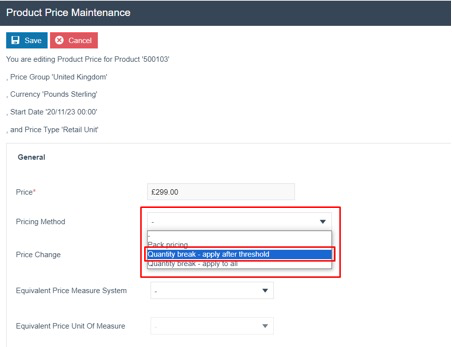
Create a list of threshold values by entering the Quantity and Price for each tier, then selecting + Add.

Click Save to apply the changes.
This completes the Quantity Break - Apply after Threshold configuration.
Pack Pricing
With Pack Pricing, the defined price applies only for the specific quantity configured - the pack price is applied exclusively at that quantity.
For example: if a customer purchases a quantity of 10, the price changes to 45 per item; if they purchase 20, the price changes to 40 per item.
Navigate to Product Maintenance and click the Edit icon of a product. Select the Prices tab and click + Add.
From the Pricing Method drop-down, select Pack pricing. The Quantity Prices tab becomes available.
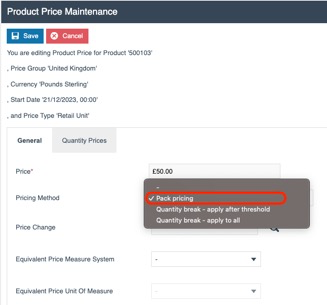
Enter each pack quantity and the corresponding price, then select + Add to add the entry to the list.
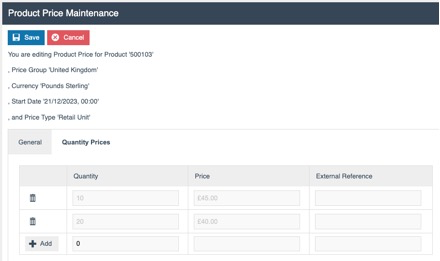
Select Save to save the new prices.
This completes the Pack Pricing configuration.
Broadcasting
To deliver the configuration changes to the POS, broadcast the following entities: Product, Product Price.
Refer to the How-to Guide - Configuring Data and Regional Broadcasting for instructions on broadcasting configuration data to the estate.
This completes the Broadcasting configuration.
POS Functionality
The POS operator enters or scans the Product ID or Selling Code of the product.
Standard Pricing - POS Behaviour
When the item is added to the basket, the configured price is used.

Price by Measurements - POS Behaviour
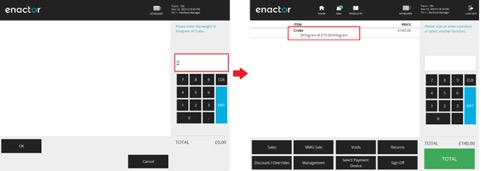
When the item is added to the basket, the POS operator is prompted for the quantity of the unit of measure specified in the price. Once entered and confirmed, the POS calculates the item price.
Quantity Break - Apply to All - POS Behaviour
When items are added to the basket, the POS applies the break price to all items once the threshold quantity is reached.
For example: if a product costs 2.99 per unit for three or fewer items, the price per unit decreases to 2.59 for four or more - including the items already added.
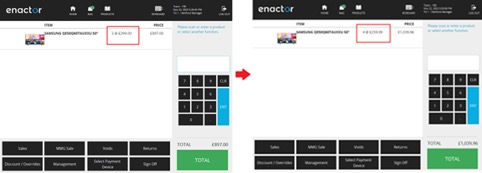
Quantity Break - Apply after Threshold - POS Behaviour
When items are added to the basket, the POS applies the break price only to items sold above the threshold. Items at or below the threshold retain the original price.
For example: if three or fewer items are purchased, the price per unit is 2.99; if four or more are purchased, the price drops to 2.59 for subsequent items; and if seven or more are purchased, the price drops further to 2.35 for subsequent items.
