How To Configure Promotions
The purpose of this guide is to provide a foundational understanding of the options and capabilities available when designing Promotions in the Enactor system. The Enactor Promotions Engine is extremely powerful and flexible while remaining easy to manage, providing nearly limitless capabilities when defining offer qualifications and rewards.
All activity required to define and configure a new offer is completed within the Promotions Maintenance application. However, offer behaviour can be influenced by additional factors such as Regions, Locations, MMG hierarchy, Brands, Product Groups, Loyalty Programmes, and others. A system should be fully configured and loaded with all master data before proceeding with Promotions setup.
This guide focuses on the core concepts of Promotions configuration. For a detailed account of all available options, refer to the full Enactor Application Configuration book.
Overview
This guide covers the configuration for the following:
- Promotion Fundamentals - Core concepts: Transaction vs Item Level promotions, Triggers, Rewards, Manner of Application, and Timetable.
- Manner of Application - General tab settings controlling how a Promotion is applied.
- Promotion Timetable - Configuring active dates and times.
- Additional Inclusion/Exclusion Criteria - Restricting Promotions by Customer, Employee, Tender, Voucher, Region, Fascia, and Location.
- Transaction Promotion Types - The 9 transaction-level Promotion Types and their Reward configuration.
- Transaction Threshold Types - Qualification thresholds for Transaction Promotions.
- Item Sets - Defining item-level qualification and reward groups.
- Item Set Promotion Types - The 19 item-level Promotion Types.
- Item Set Threshold Types - Qualification thresholds for Item Set Promotions.
- Broadcasting - Delivering Promotions to POS devices.
Prerequisites
Resources
Before starting, the following resources should be in place:
- Enactor Estate Manager
- Enactor POS (configured and connected to the Estate Manager)
- Standard Configuration (Base Configuration and appropriate regional config pack)
- Regionally appropriate data including Products, Localisation, Tenders, and Vouchers
- Customer configuration including Loyalty, Tiers, and Groups
Prior Training/Experience
You should be familiar with the following:
- Estate Manager configuration
- Enactor configuration concepts: Locations, POS Terminals, Products
- Data broadcasting
- Standard POS Sales processes
Promotion Fundamentals
Nature of the Promotion
The Enactor Promotions Engine categorises all promotions into one of two types: Transaction Level or Item Level. Transaction Level Promotion rewards are applied against the entire transaction. Item Level rewards are applied to specific items or groups of items in a transaction.
Promotion Trigger
Transaction Level Promotions are triggered by the entire transaction meeting the qualifying threshold (value, quantity, points, etc.). Additional Inclusion/Exclusion rules can be imposed for attributes such as Loyalty Membership, Customer Segment, Regions, Location, and more.
Item Set Inclusion/Exclusion
Item Level Promotions are triggered by meeting the qualifying threshold (value, quantity, points, etc.) of a particular item or group of items within the transaction. As with Transaction Level Promotions, additional Inclusion/Exclusion rules can be imposed.
Promotion Reward
When a Promotion is triggered, a Reward is provided. The specific type and value of the Reward are defined as part of the Promotion configuration. A large number of Reward types are supported, including Discounts, Vouchers, Free Items, Fee Override, Gift Cards, and others.
Manner of Application
The manner in which a Reward is applied is defined through configuration and is specific to the Promotion. This includes how the Reward behaves during returns and how it interacts with other Promotions, Discounts, and Overrides.
Promotion Timetable
Promotions are typically effective over a specific range of dates. Beginning and ending dates can be specified for each offer. Promotions can also be limited to specific times of day and/or days of the week.
Configuration
Promotions are configured in the Promotions Maintenance application.
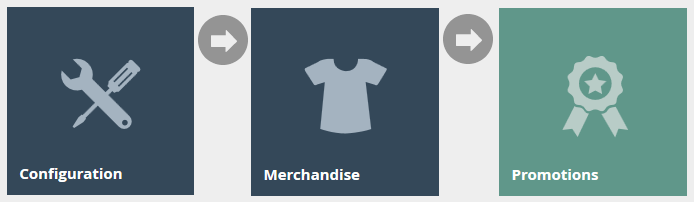
Navigate to Promotions using the Search or the path: Main Menu > Configuration > Merchandise > Promotions
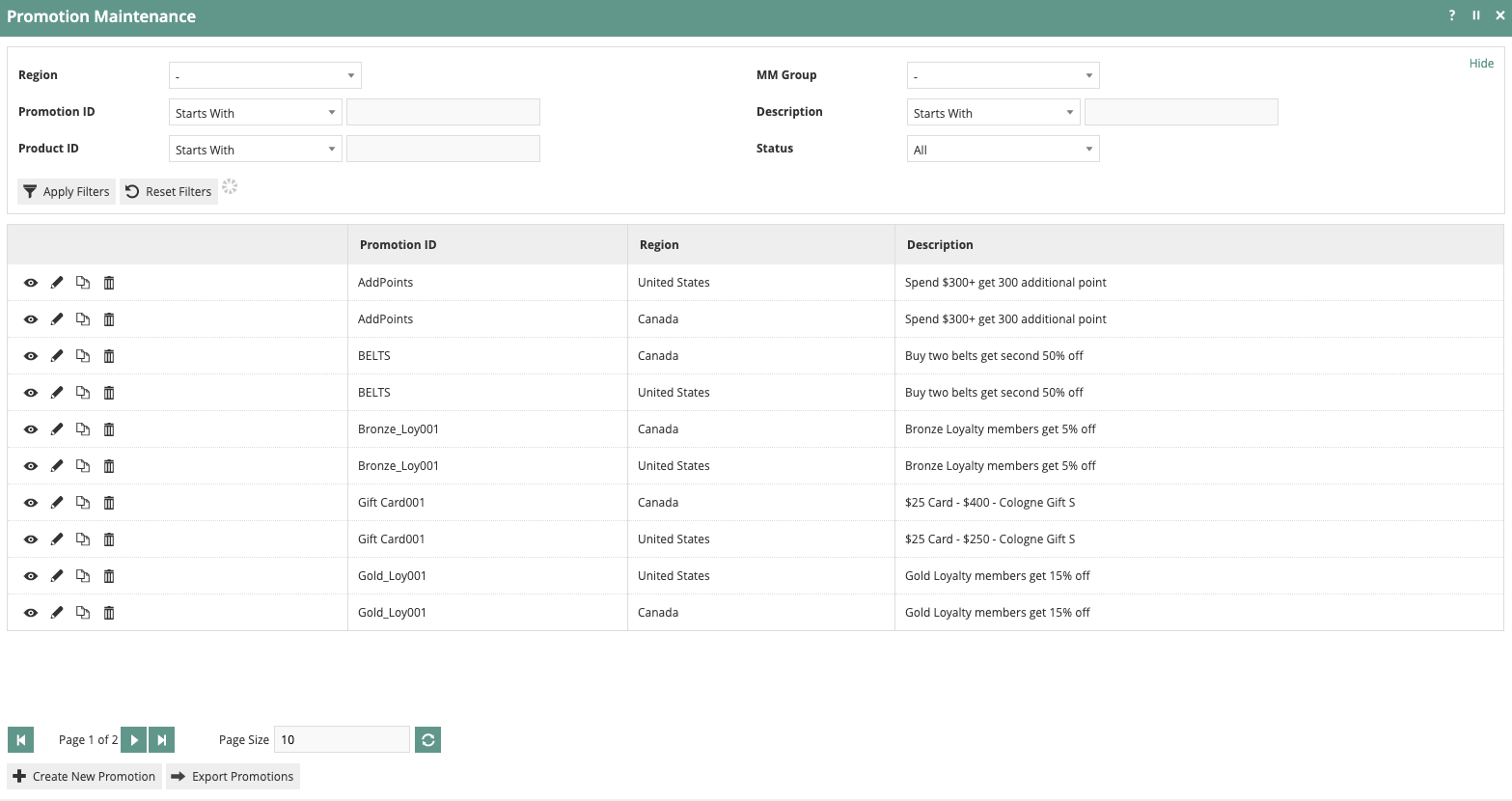
The Promotions Maintenance page displays all existing promotions, which can be filtered by Region, Promotion ID, Product ID, MM Group, Description, or Status:
Select Create a new Promotion to add a new Promotion. If the Promotion is for a specific Region, select it from the dropdown. Otherwise, leave it as All Regions. Each Promotion must have a unique Promotion ID per Region, which can be automatically generated if not specified:

| Field | Description |
|---|---|
| Region | Select the Region for which the Promotion applies, or leave as All Regions. |
| Promotion ID | A unique identifier for the Promotion within the selected Region. |
| Autogenerate ID | If selected, the system will generate a unique Promotion ID automatically. |
Manner of Application
Numerous tabs are displayed within Promotion Maintenance. The options on the General tabs primarily control how the Promotion is applied.
The General - General tab is where the core Promotion properties are configured:
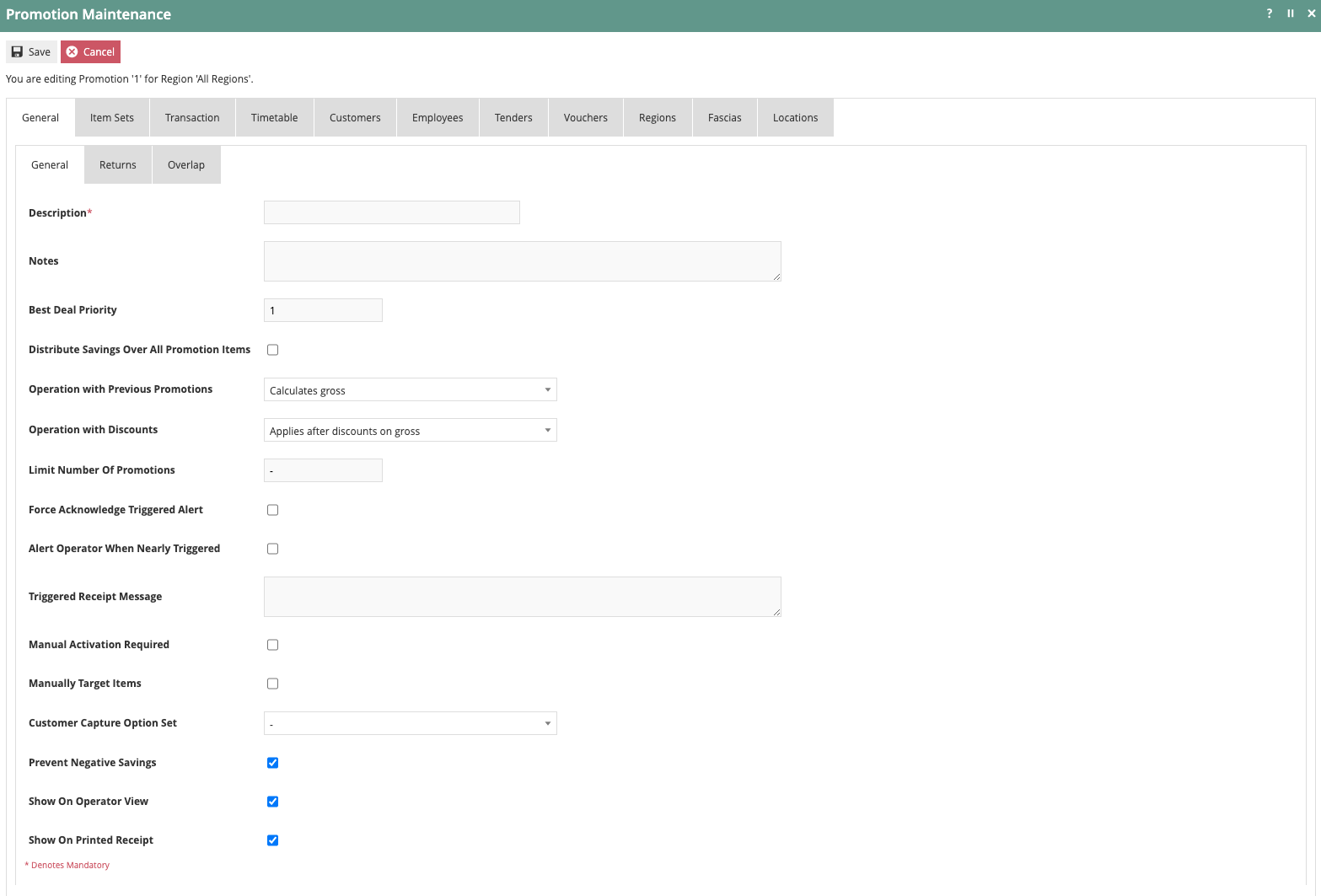
| Field | Description |
|---|---|
| Description | Required. The description displayed on the operator screen and receipt when the Promotion is triggered. |
| Notes | Optional. A more detailed internal description not visible to cashiers or customers. |
| Best Deal Priority | Overrides Best Deal Logic to force certain Promotions over others. Use only when necessary. |
| Distribute Savings Over All Promotion Items | If selected, distributes the total discount proportionally across all qualifying items (for accounting purposes). Does not affect the discount amount. |
| Operation with Previous Promotions | Defines how this Promotion interacts with other Promotions applied to the same transaction. |
| Operation with Discounts | Defines how this Promotion interacts with manual Discounts. |
| Limit Number of Promotions | Restricts how many times the Promotion can trigger within a single transaction. If blank, it triggers as many times as needed. |
| Force Acknowledge Triggered Alert | Displays a pop-up message to the operator when the Promotion is triggered, requiring acknowledgement. |
| Alert Operator When Nearly Triggered | Displays a near-miss alert to entice further purchases when the customer is close to qualifying. |
| Prevent Negative Savings | Prevents the Promotion from resulting in a negative saving. |
| Show On Operator View | Displays the Promotion on the operator screen when triggered. |
| Show On Printed Receipt | Prints the Promotion description on the customer receipt when triggered. |
When Force Acknowledge Triggered Alert or Alert Operator When Nearly Triggered is enabled, additional message fields are displayed:

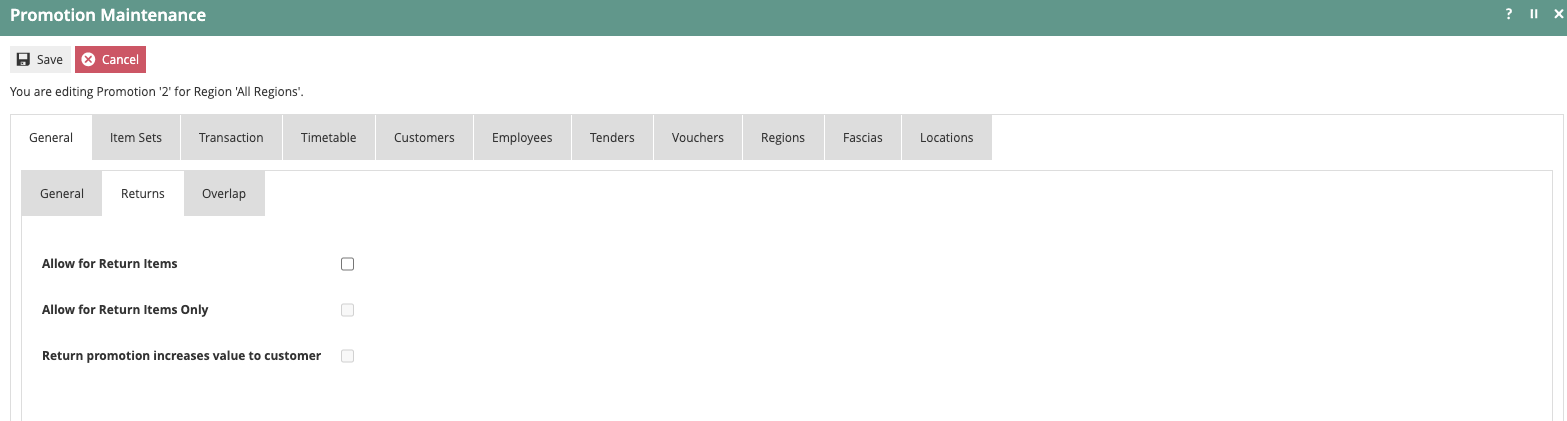
The General - Returns tab controls Promotion behaviour during return transactions. These settings do not need to be changed for normal receipted returns:

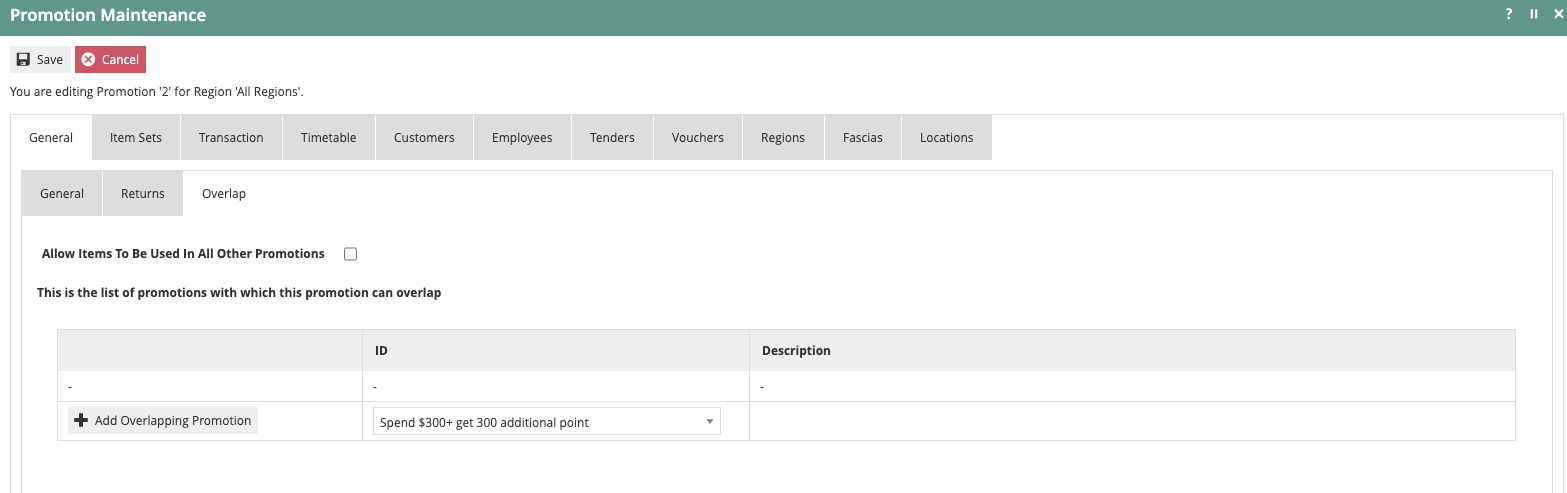
The General - Overlap tab controls how the items involved in this Promotion interact with other Promotions. To allow items to be used in all other eligible Promotions, select Allow Items To Be Used In All Other Promotions. To restrict overlap to specific Promotions, add them individually using Add Overlapping Promotion. To disallow all overlap, leave the option unselected and the list empty:
This completes the Manner of Application configuration.
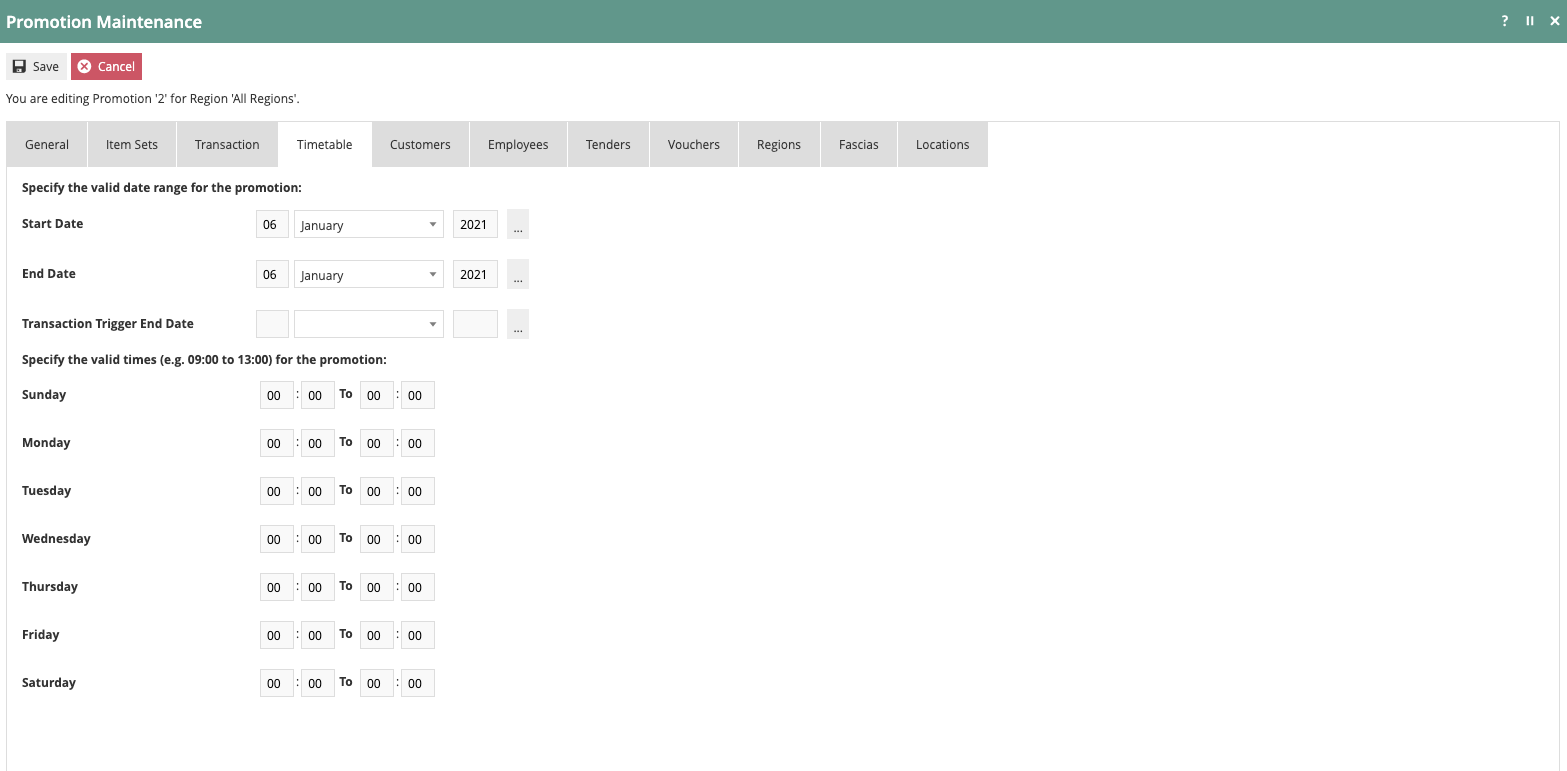
Promotion Timetable
Managing when a Promotion is valid is accomplished on the Timetable tab. Promotions can be set up and broadcast in advance of their active dates.
| Field | Description |
|---|---|
| Promotion Start Date | The first day the Promotion is active. |
| Promotion End Date | The last day the Promotion is active. |
| Transaction Trigger End Date | Stops the Promotion from triggering automatically after this date, while keeping it available for manual activation. |
| Valid Times | Day-of-week and time-of-day restrictions. If no times are specified, the Promotion is active all day. |
If no dates are specified, a Promotion will be active immediately upon broadcast and remain active until an End Date is supplied or the Promotion is removed.
This completes the Promotion Timetable configuration.
Additional Inclusion/Exclusion Criteria
In addition to the Timetable, several other factors can influence the validity of a Promotion.
Customers tab
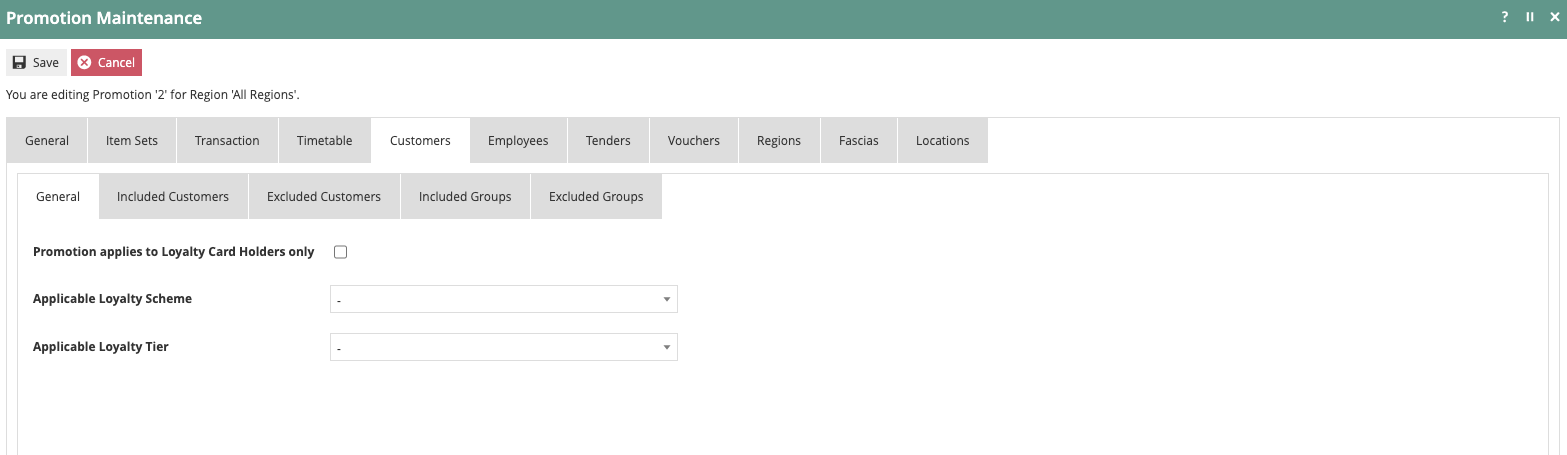
The Customers tab provides Include/Exclude options based on Customer attributes.
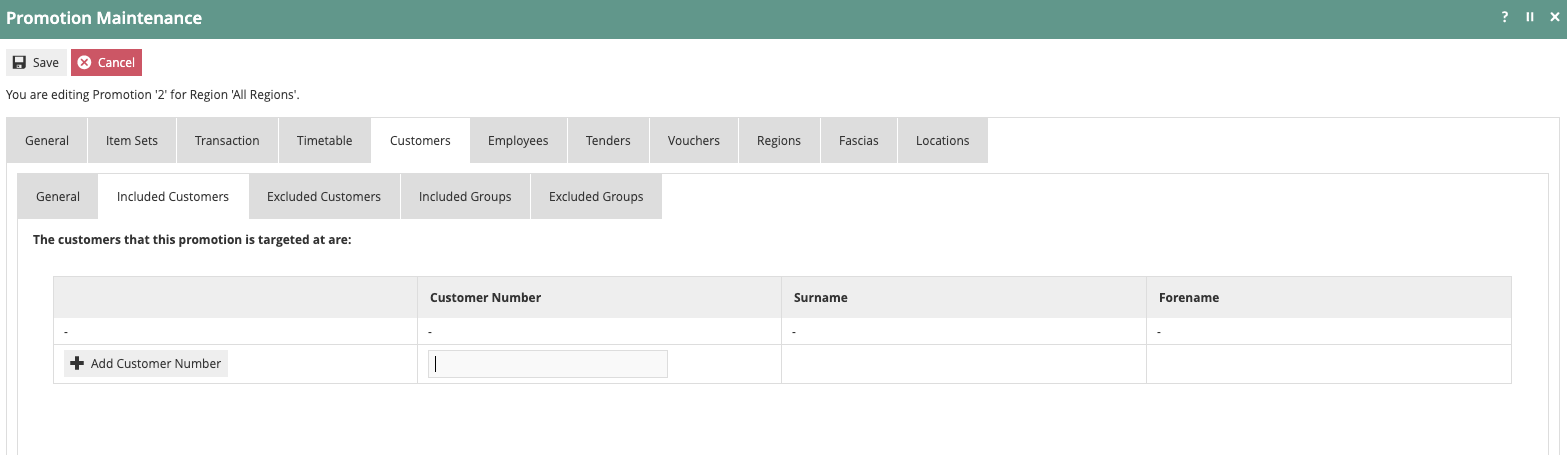
Individual customers can be added to the Included Customers or Excluded Customers lists by entering the customer number and clicking Add Customer Number:
The Included Groups and Excluded Groups tabs allow Inclusion or Exclusion of specific Customer Groups. Select the desired Group from the dropdown and click Add Customer Group:
Employees tab
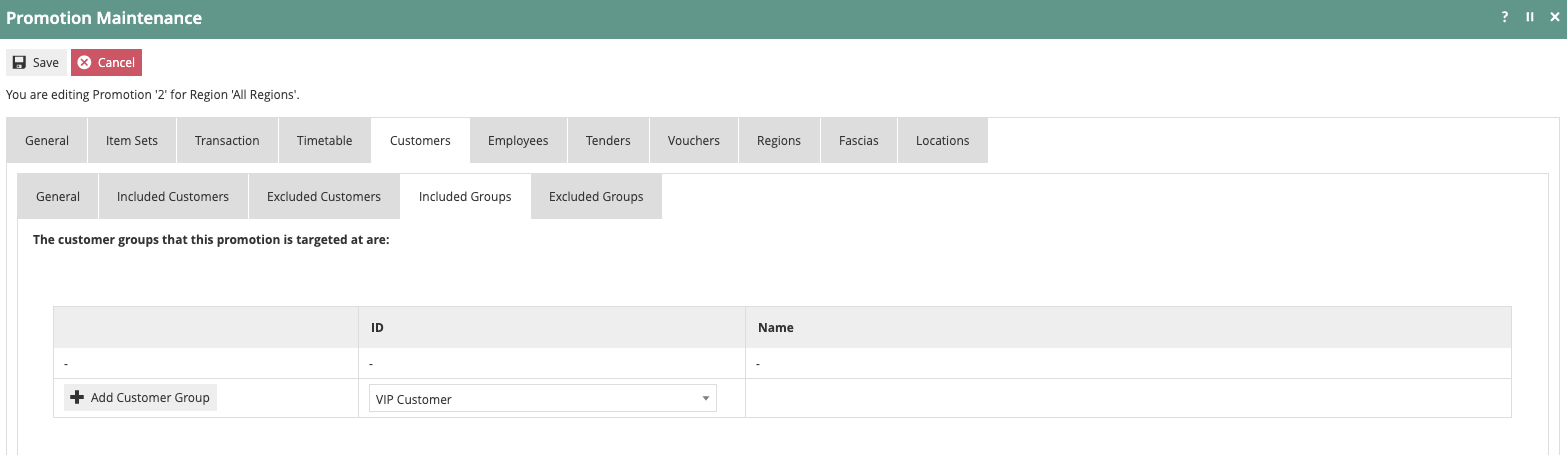
The Employees tab controls a Promotion's validity within Employee Sale transactions. To make a Promotion valid within an Employee Sale, select Enable this Promotion during Employee Sales. Selecting Restrict to Employee Sales only limits the Promotion exclusively to Employee Sales. The Update Employee Discount Balance with savings option causes Promotional discounts to count towards an Employee's discount limit:
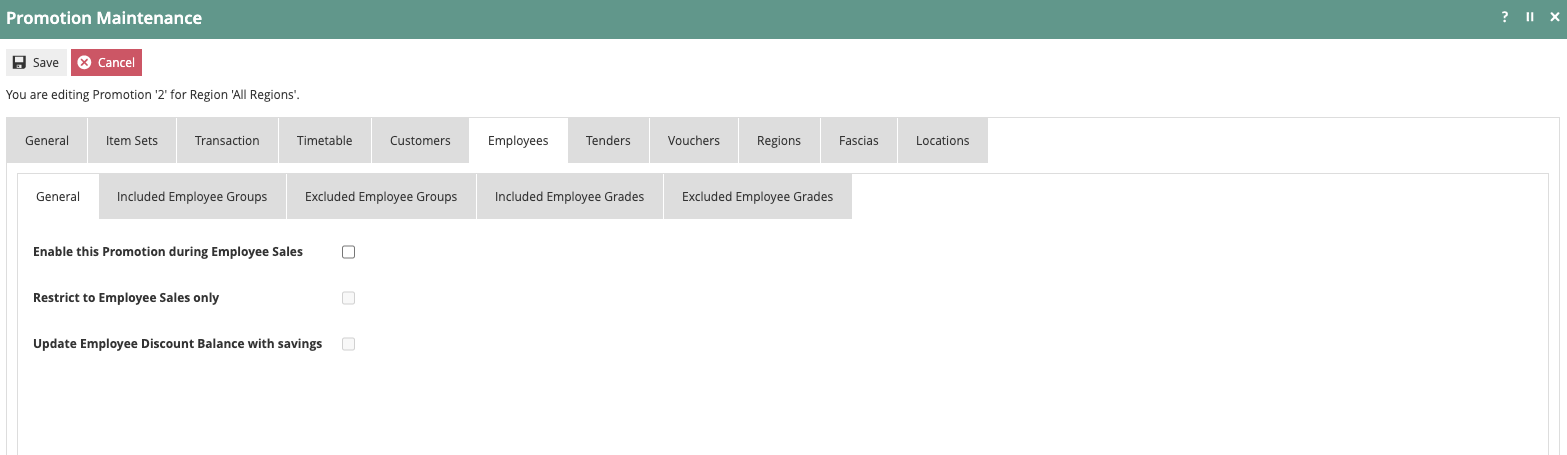
If Employee Groups have been defined, they can be Included or Excluded on the Included/Excluded Employee Groups tabs. Select the group and click Add Employee Group:
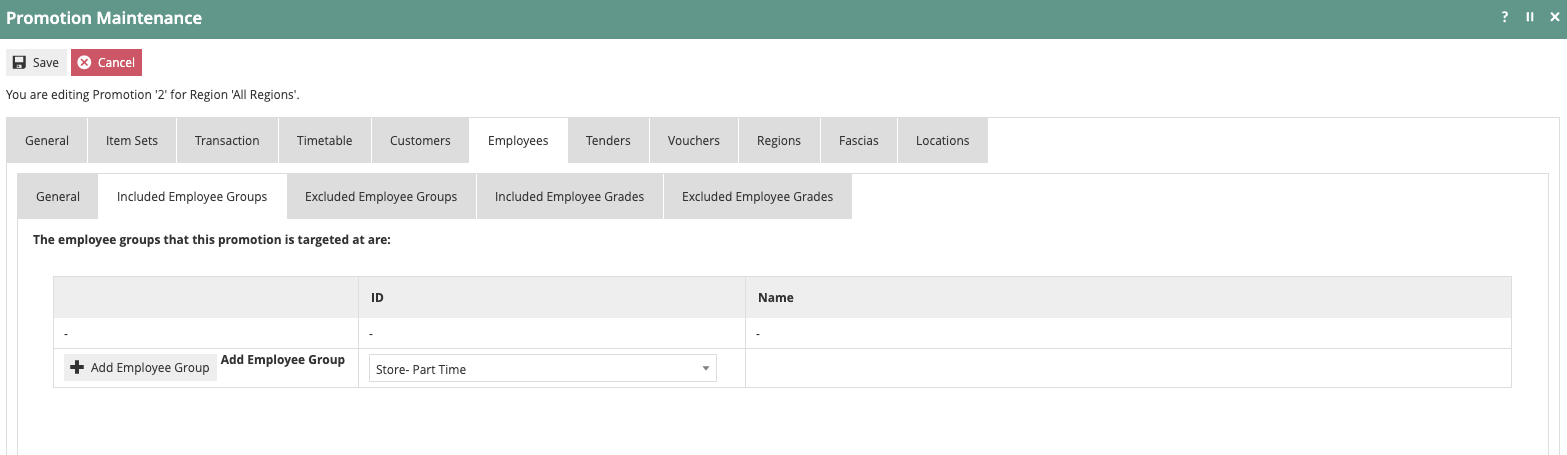
Employee Grades can similarly be Included or Excluded on the Included/Excluded Employee Grades tabs:
Tenders tab
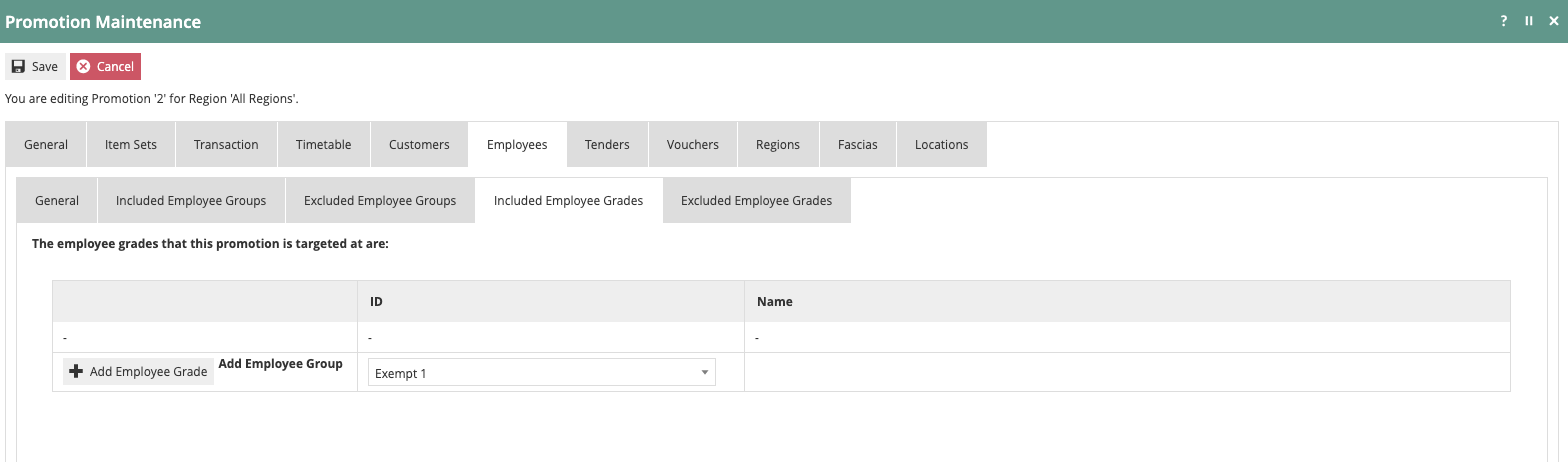
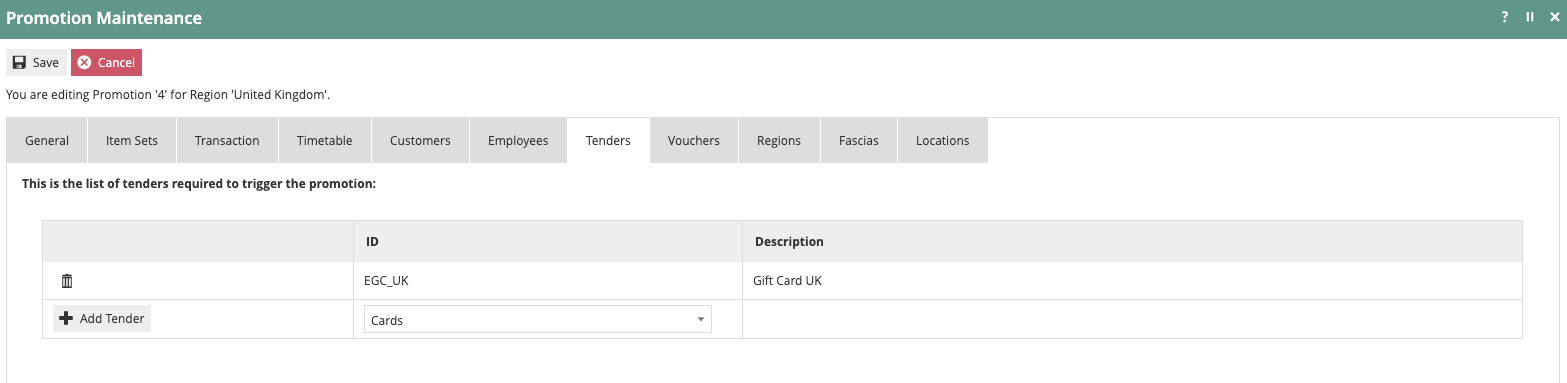
Promotions can be linked to the use of a specific Tender. Select the desired Tender ID from the dropdown and click Add Tender. Since the Promotion is not triggered until the tender has been selected, the transaction flow is unique. The Enable Promotion Check in Tendering option must be enabled for the specific Tender in Tender Maintenance for this to work:
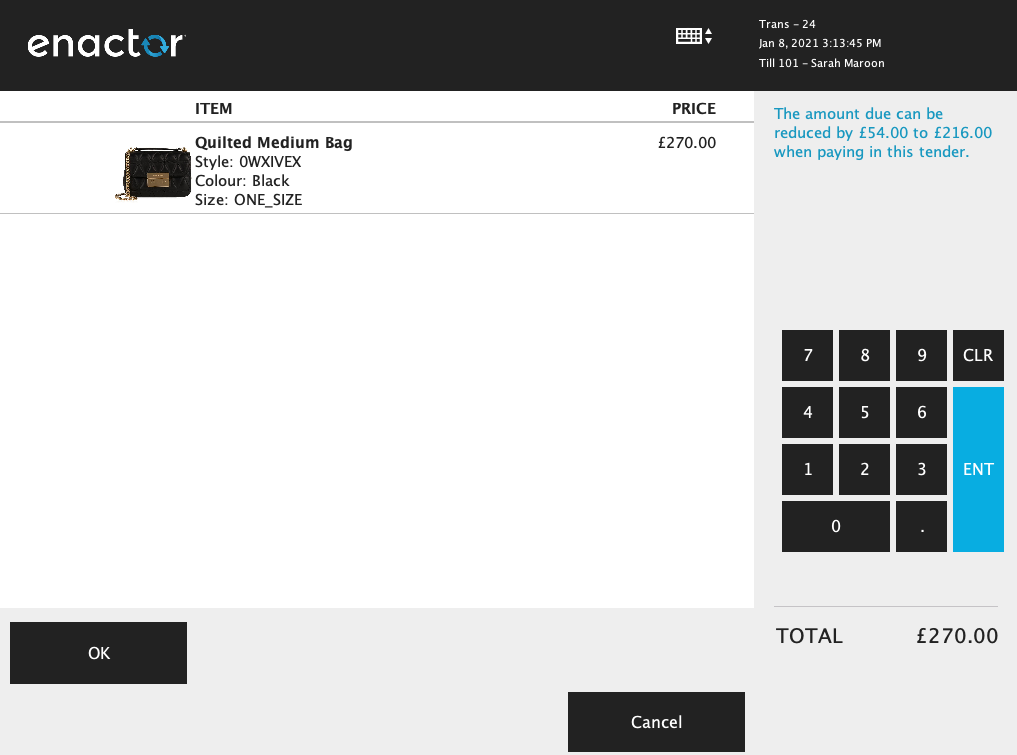
When a Tender-triggered Promotion qualifies, the operator receives a message on the terminal showing the updated total:
Vouchers tab
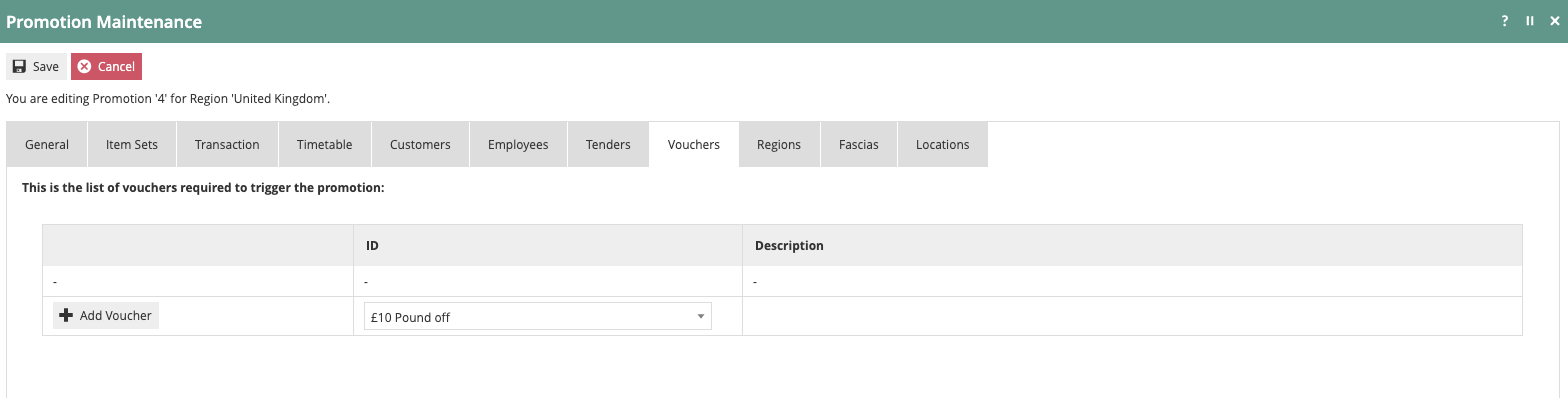
Promotions can be triggered through the use of Vouchers. Select the required Voucher from the dropdown and click Add Voucher. The customer must present the appropriate Voucher to qualify for the Promotion:
Regions tab
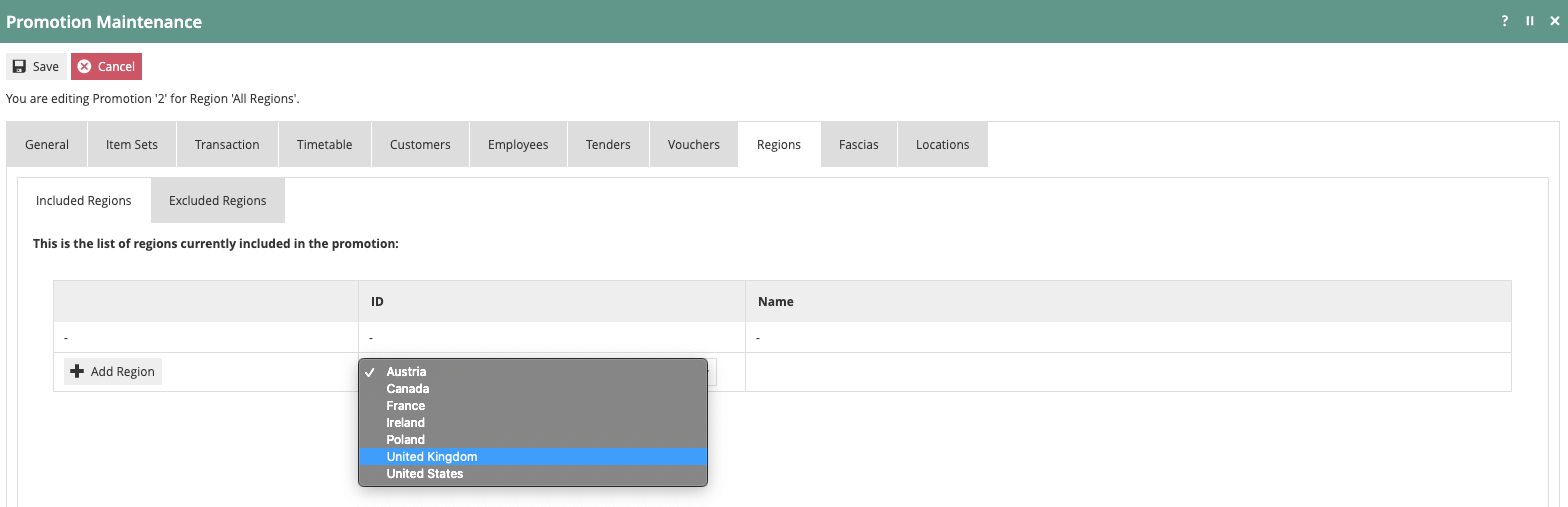
On the Regions tab, it is possible to Include or Exclude the Promotion at a Region level lower than the level at which it was created. Select the desired region from the dropdown and click Add Region:
Fascias tab
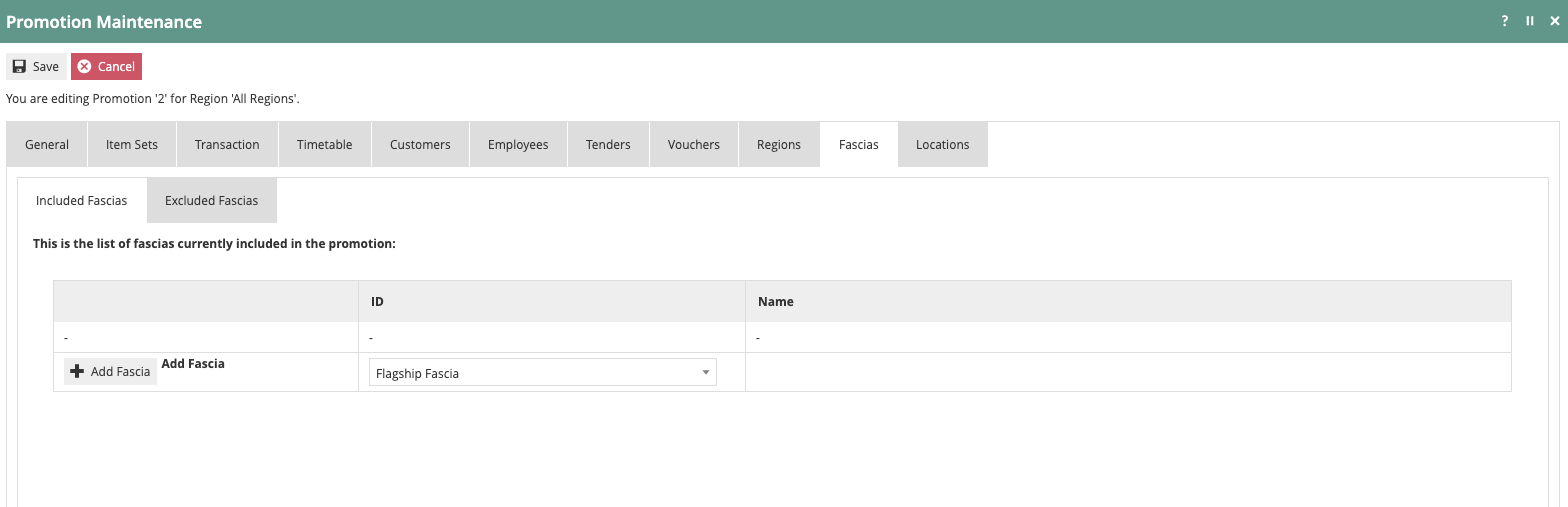
Retailers operating more than one Fascia can Include or Exclude Promotions at the Fascia level. Select the desired Fascia from the dropdown and click Add Fascia:
Fascias are tied to Regions. For a Fascia to appear as an option, it must be within the same Region hierarchy as the Promotion and at the same level or below.
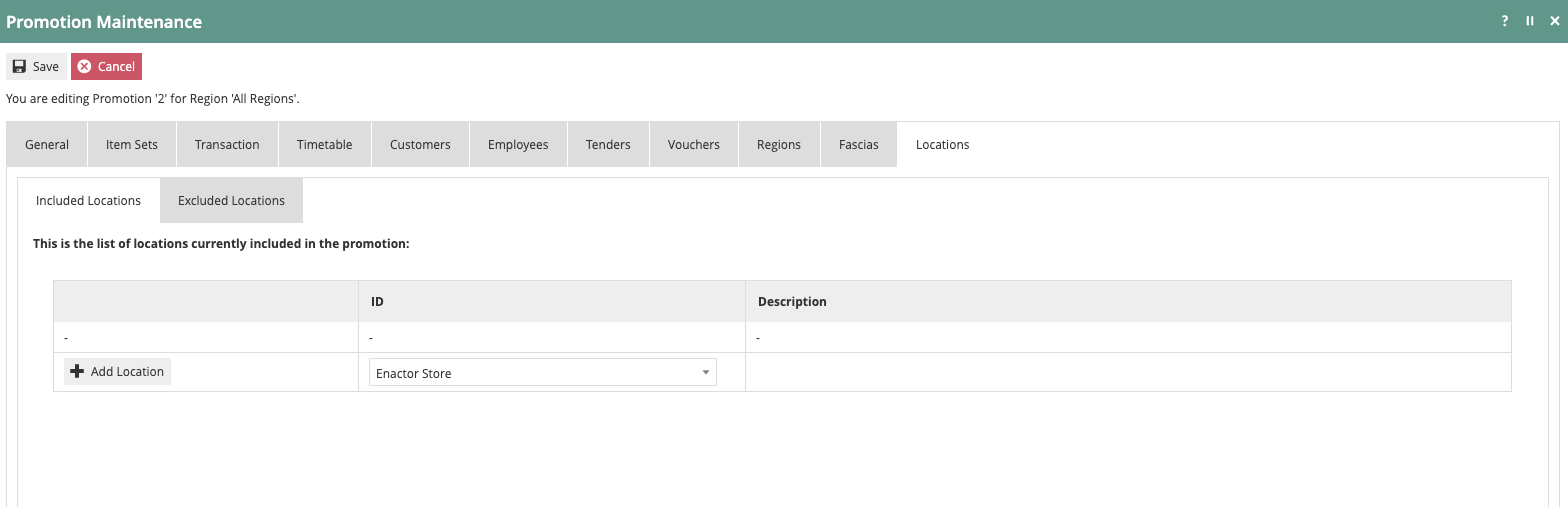
Locations tab
Using the Included Locations and Excluded Locations tabs, individual Locations can be Included or Excluded from a Promotion. Select the desired Location from the dropdown and click Add Location:
Locations will appear as options only if they are within the same Regional hierarchy as the Promotion and at the same level or below.
This completes the Additional Inclusion/Exclusion Criteria configuration.
Transaction Promotion Types
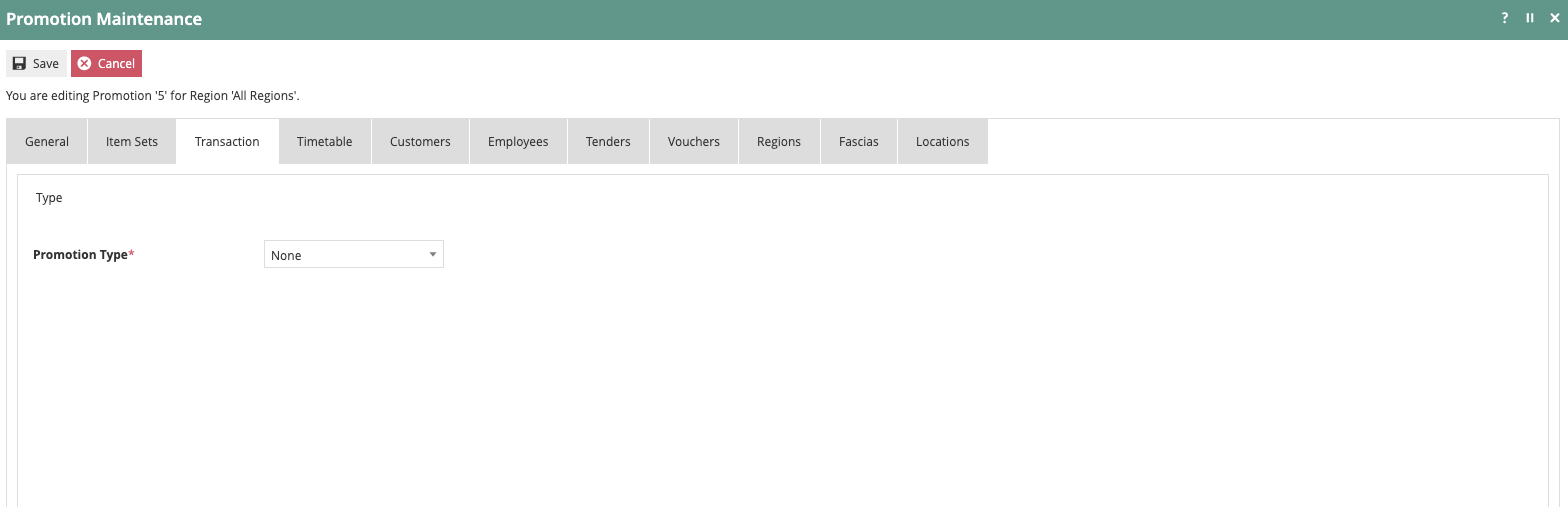
In a Transaction Promotion, qualification is evaluated at the Transaction Level and the Reward is applied at the Transaction Level. Select the Transaction tab to define the qualifiers and rewards.
There are currently 9 Transaction Promotion Types. The form displayed for Reward definition will vary based on the selected Promotion Type:
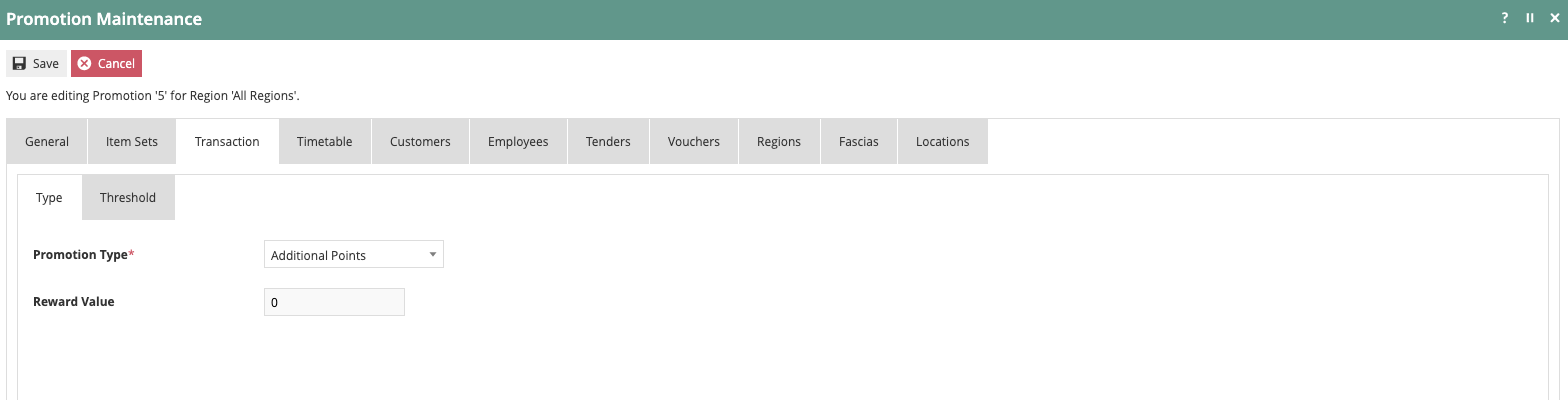
Additional Points
Rewards the customer with Additional Points deposited into their Loyalty account. The Reward Value represents the number of Additional Points to be received:
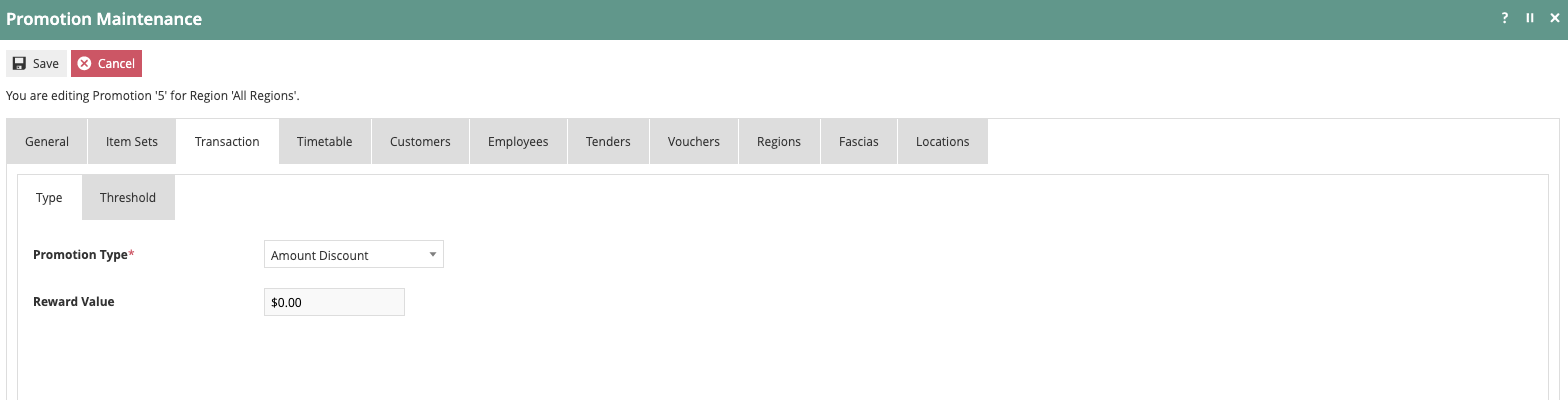
Amount Discount
Rewards the customer with a currency Amount Discount applied to the transaction. The Reward Value represents the Discount Amount:
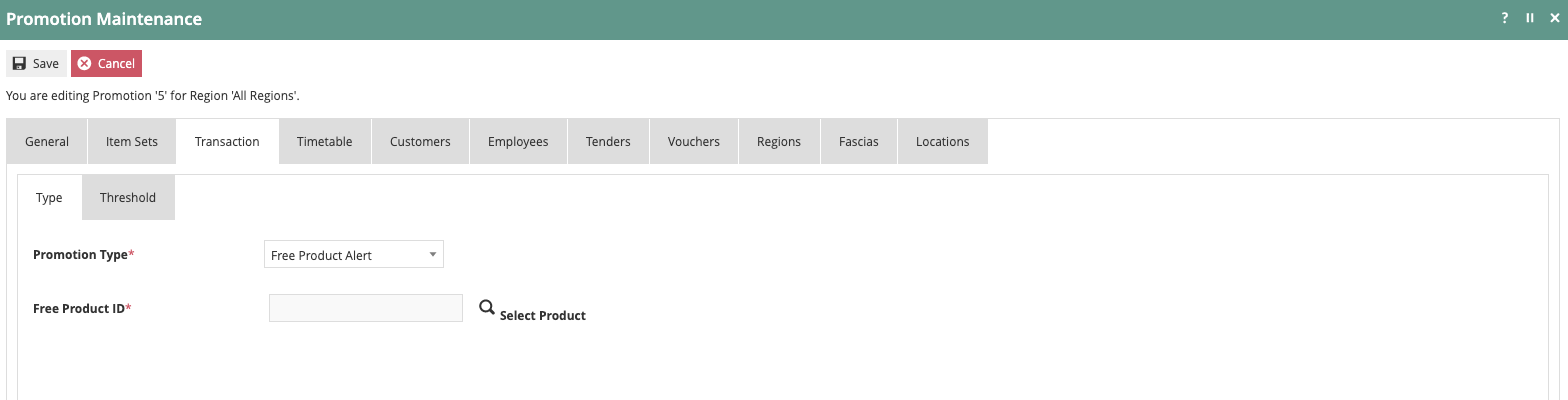
Free Product Alert
Rewards the customer with a Free Product to be given by the operator upon qualification. This Promotion requires entry of the Free Product ID:
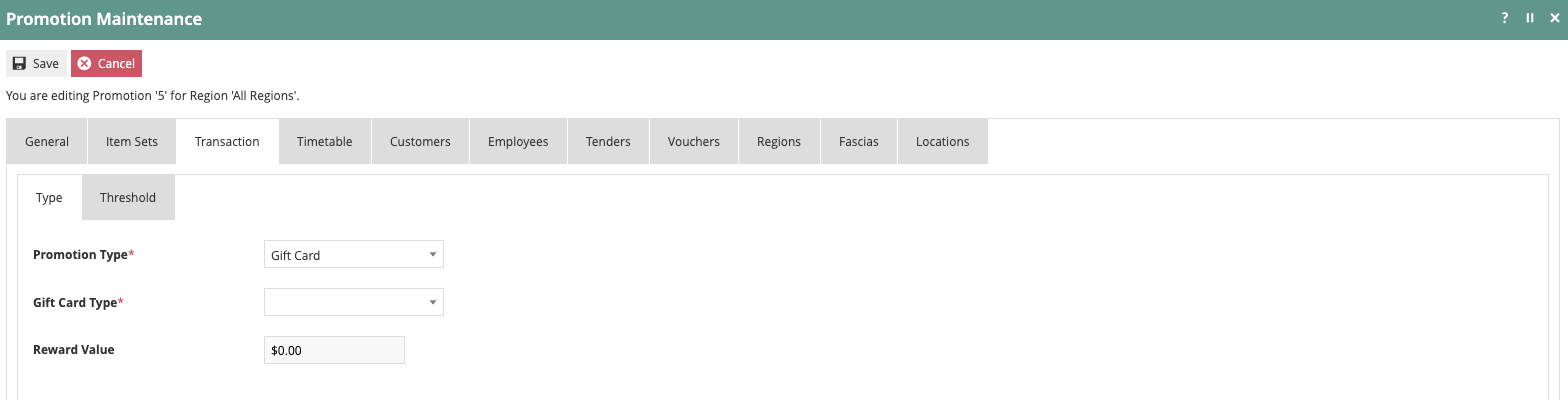
Gift Card
Rewards the customer with a Gift Card activated during the tender process. The Gift Card Type must be selected from the dropdown and the Gift Card Amount is specified in the Reward Value:
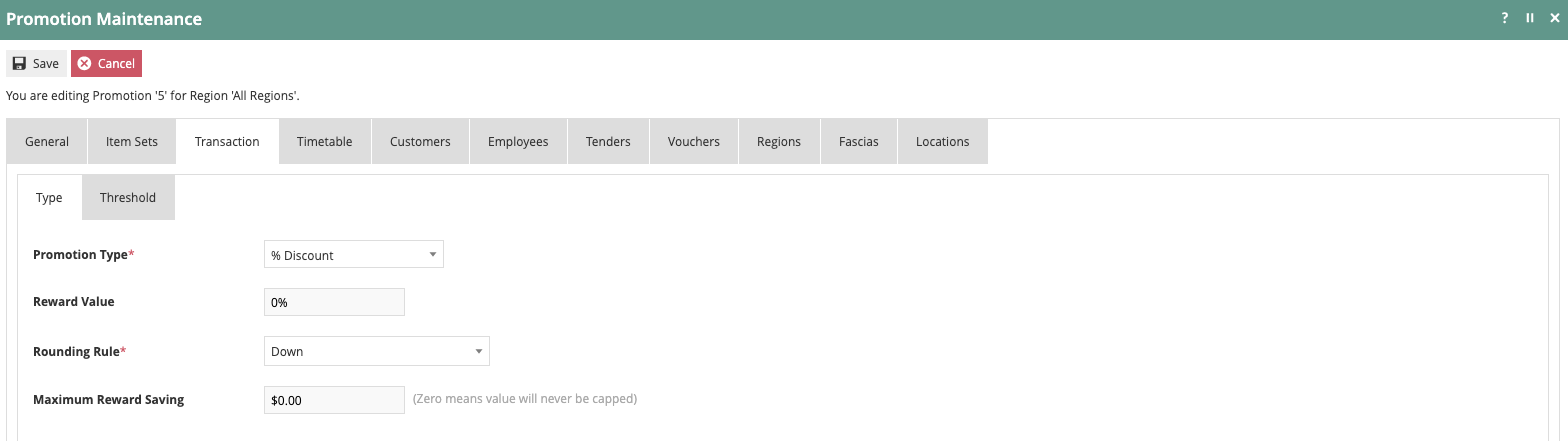
% Discount
Rewards the customer with a Percentage-based Discount applied to the transaction. The Rounding Rule determines whether the discount amount is rounded Up, Down, or to the Closest amount. A Maximum Reward Saving can be set to cap the discount:
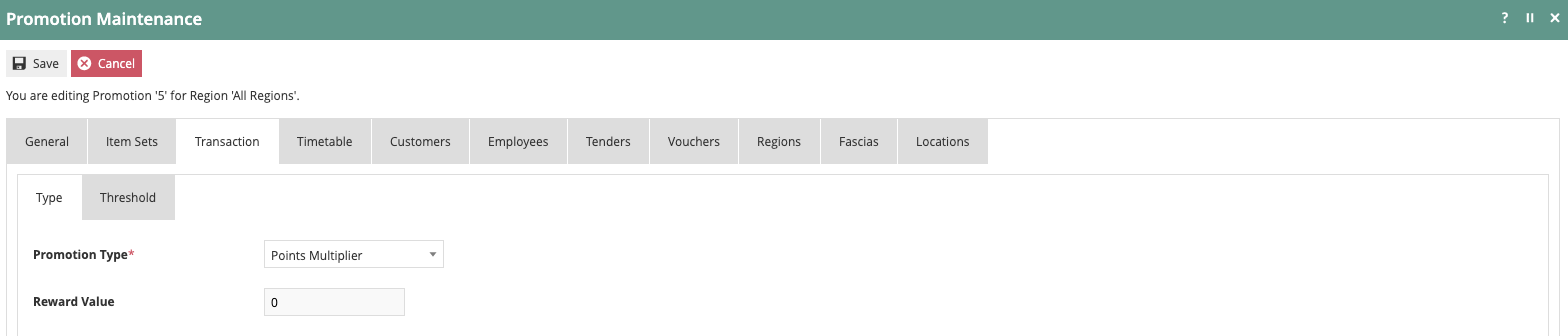
Points Multiplier
Rewards the customer with Additional Points by multiplying the Points earned in the transaction by the Reward Value:
Points Rate
Rewards the customer with Additional Points by adding Points earned in the transaction to the number of Points that would be earned using the rate entered as the Reward Value.
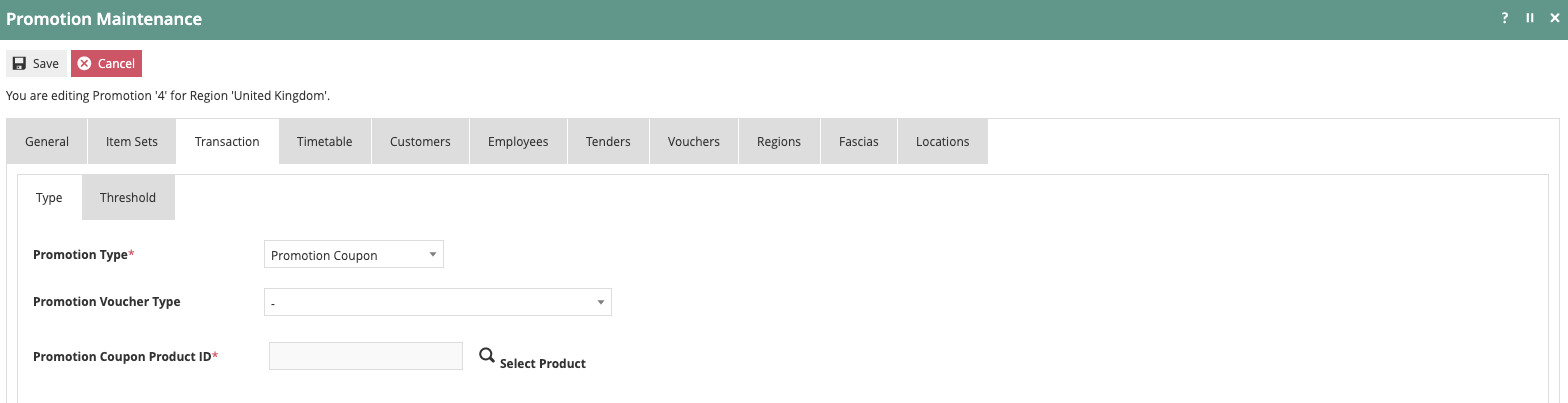
Promotion Coupon
Rewards the customer with a printed Coupon to use on a future purchase. Requires specification of the Promotion Coupon Product ID and the Promotion Voucher Type (which defines the information printed):
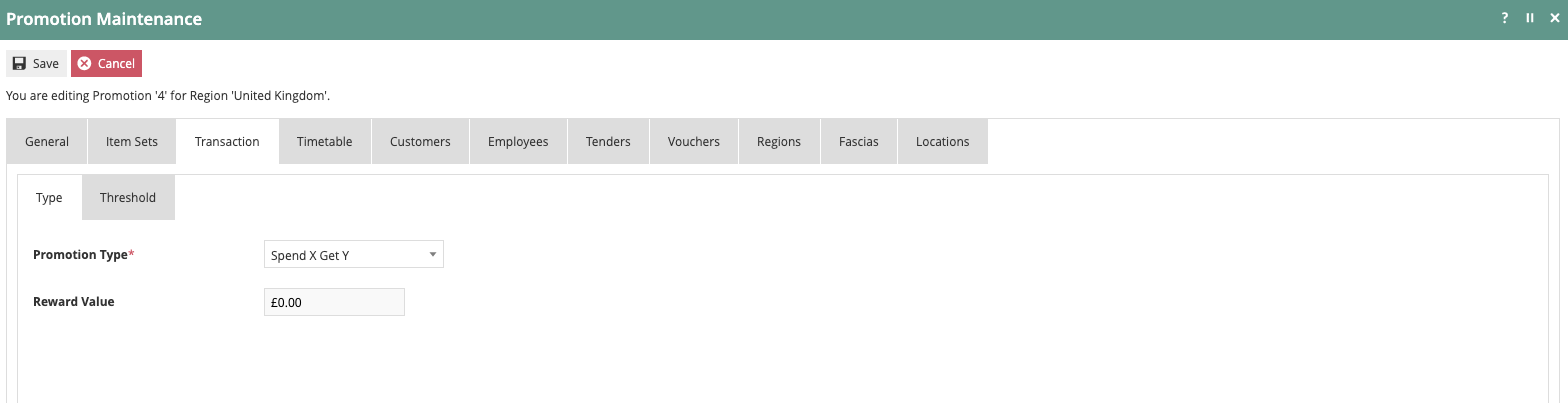
Spend X Get Y
Rewards the customer with a currency Amount Discount applied every time the qualifying Threshold is met. For example, a Spend £50 Get £5 promotion would yield £10 on a £100 transaction and £15 on a £150 transaction. The Reward Value should equal the lowest level currency Discount Amount:
This completes the Transaction Promotion Types configuration.
Transaction Threshold Types
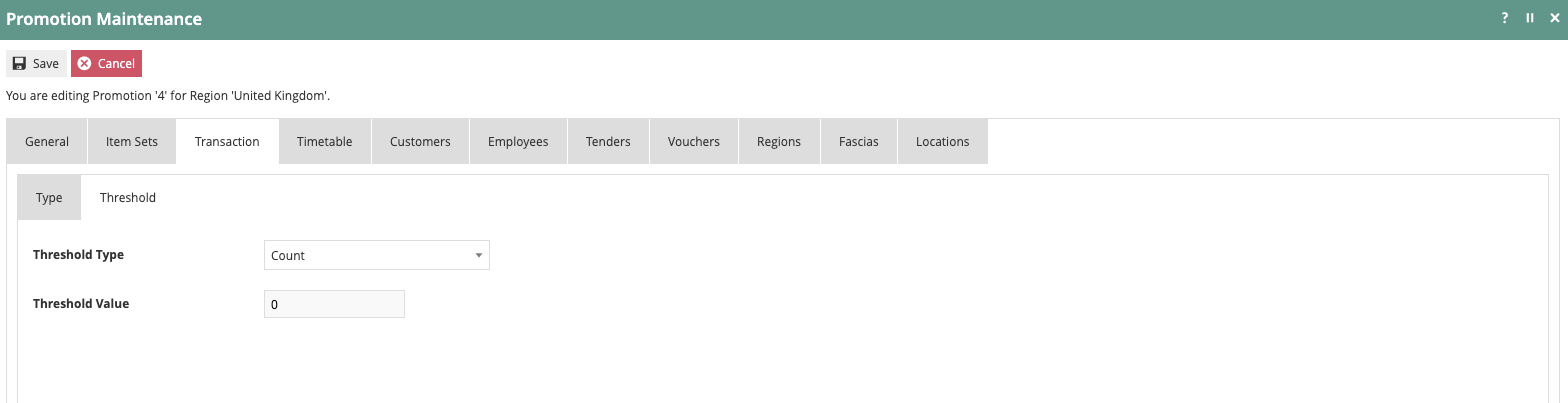
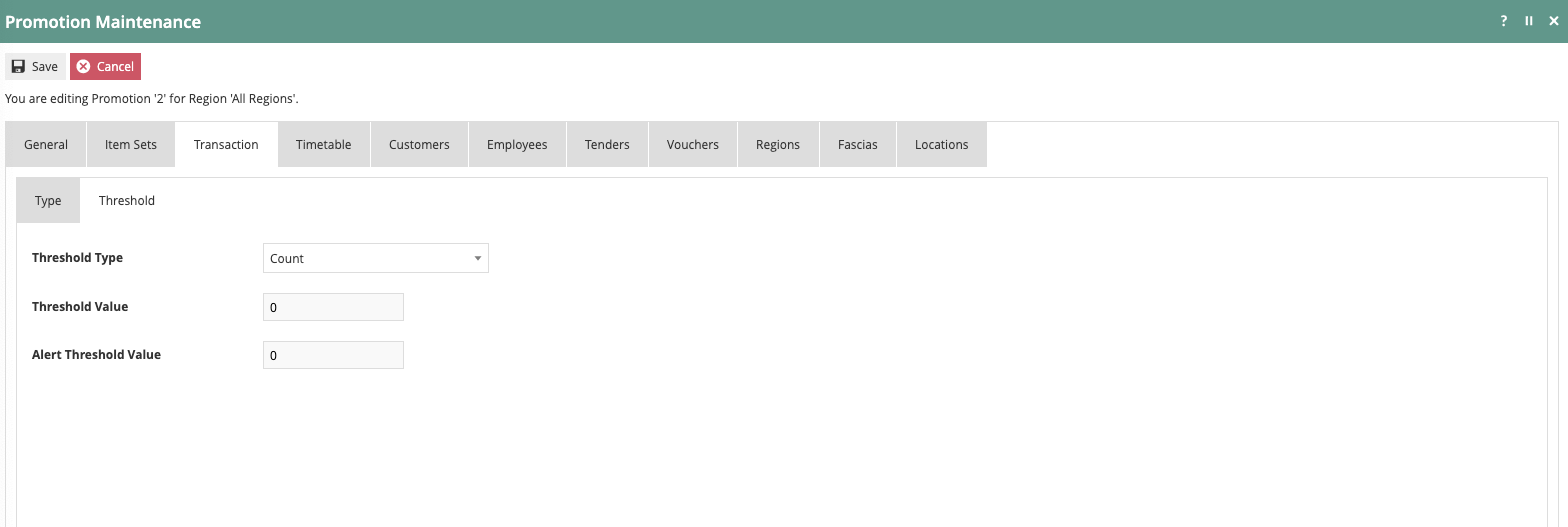
All Transaction Promotions use the same form to define the qualification Threshold. Select the Threshold Type from the dropdown and enter the desired Threshold Value:
| Threshold Type | Description |
|---|---|
| Count | The number of items in the Transaction. |
| Value | The monetary value of all items in the Transaction. |
| Points | The number of Loyalty Points earned in the Transaction. |
| Points Balance | The customer's current Loyalty Points balance. |
If the Promotion is configured to Alert Operator When Nearly Triggered, an additional Alert Threshold field is displayed. This represents the condition that must be met to trigger the near-miss alert:
This completes the Transaction Threshold Types configuration.
Item Sets
Item Sets are used to trigger Promotions based on specific Items or groups of Items within the transaction, and to confine a Reward to a particular Item or group.
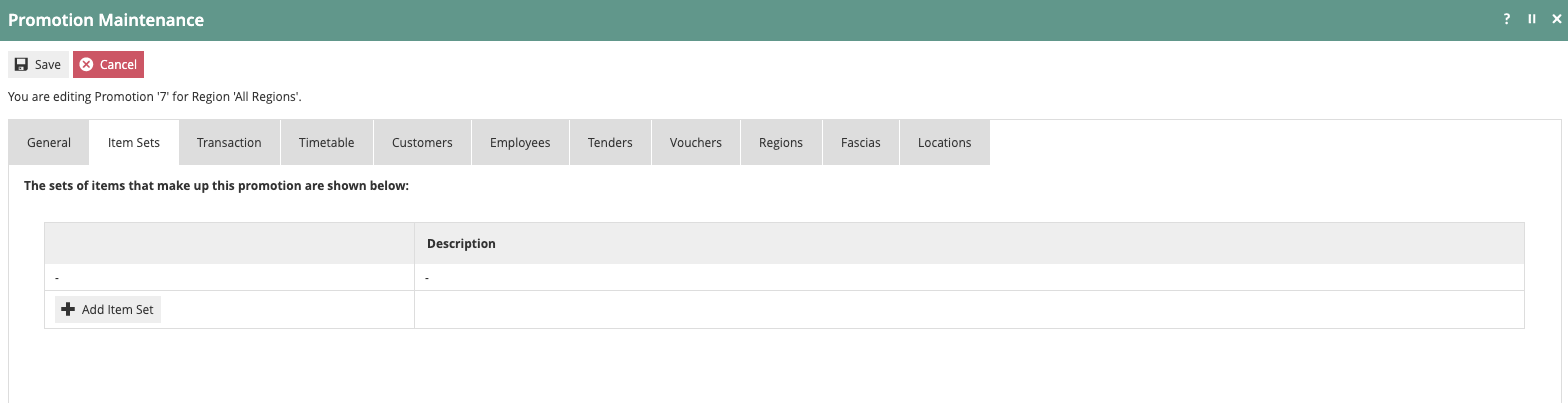
To define an Item Set, select the Item Sets tab and click Add Item Set:
It is possible and common to create more than one Item Set within a Promotion. When more than one Item Set exists, all Item Sets must be satisfied for the Promotion to be triggered.
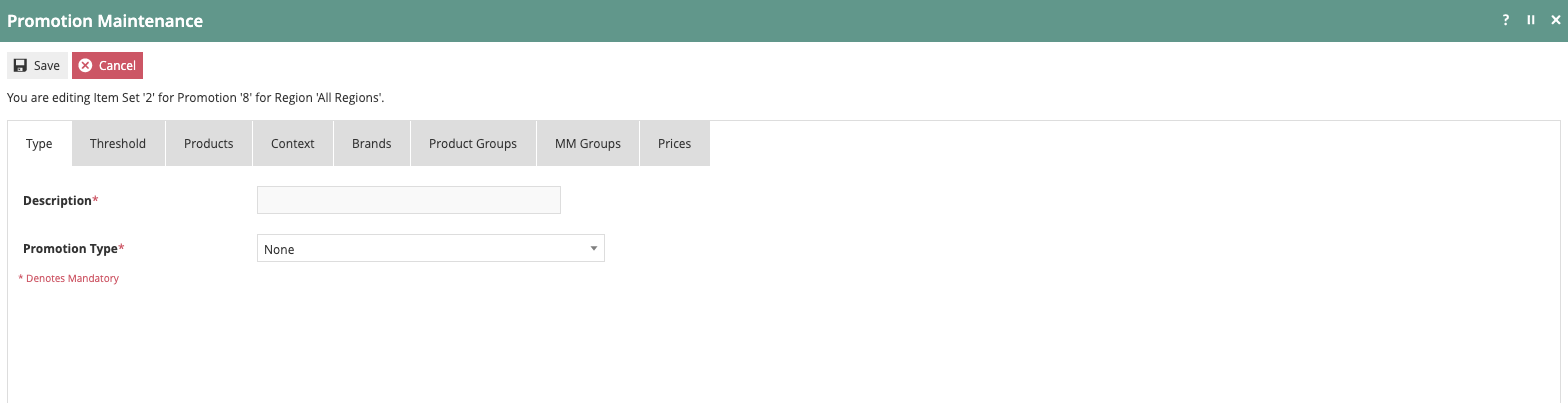
On the Item Set editing form, the Type tab is used to define the Promotion Type and Reward. The remaining tabs define which products qualify for this Item Set:
Products tab
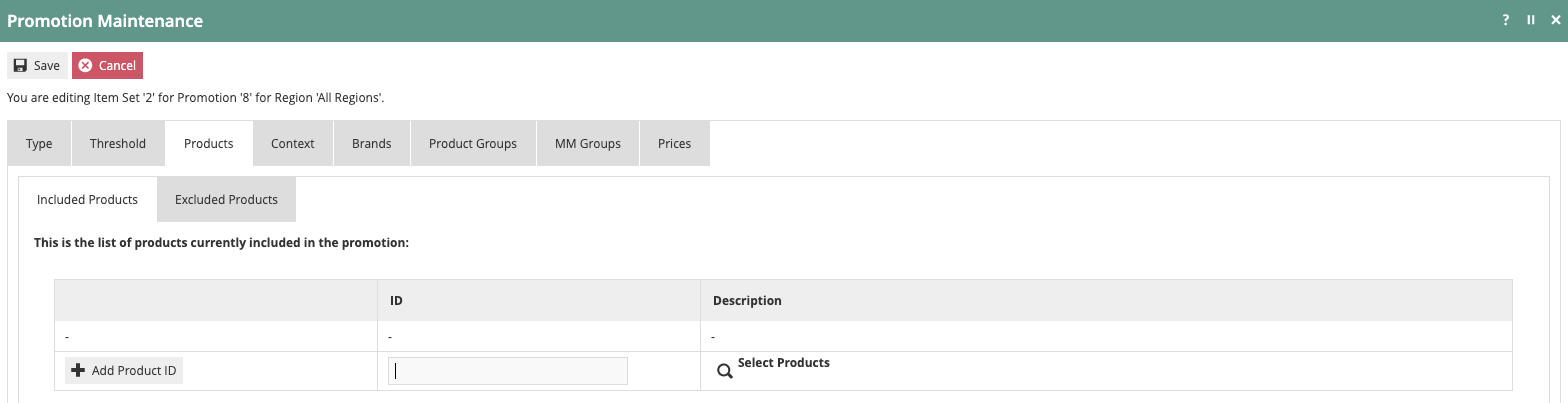
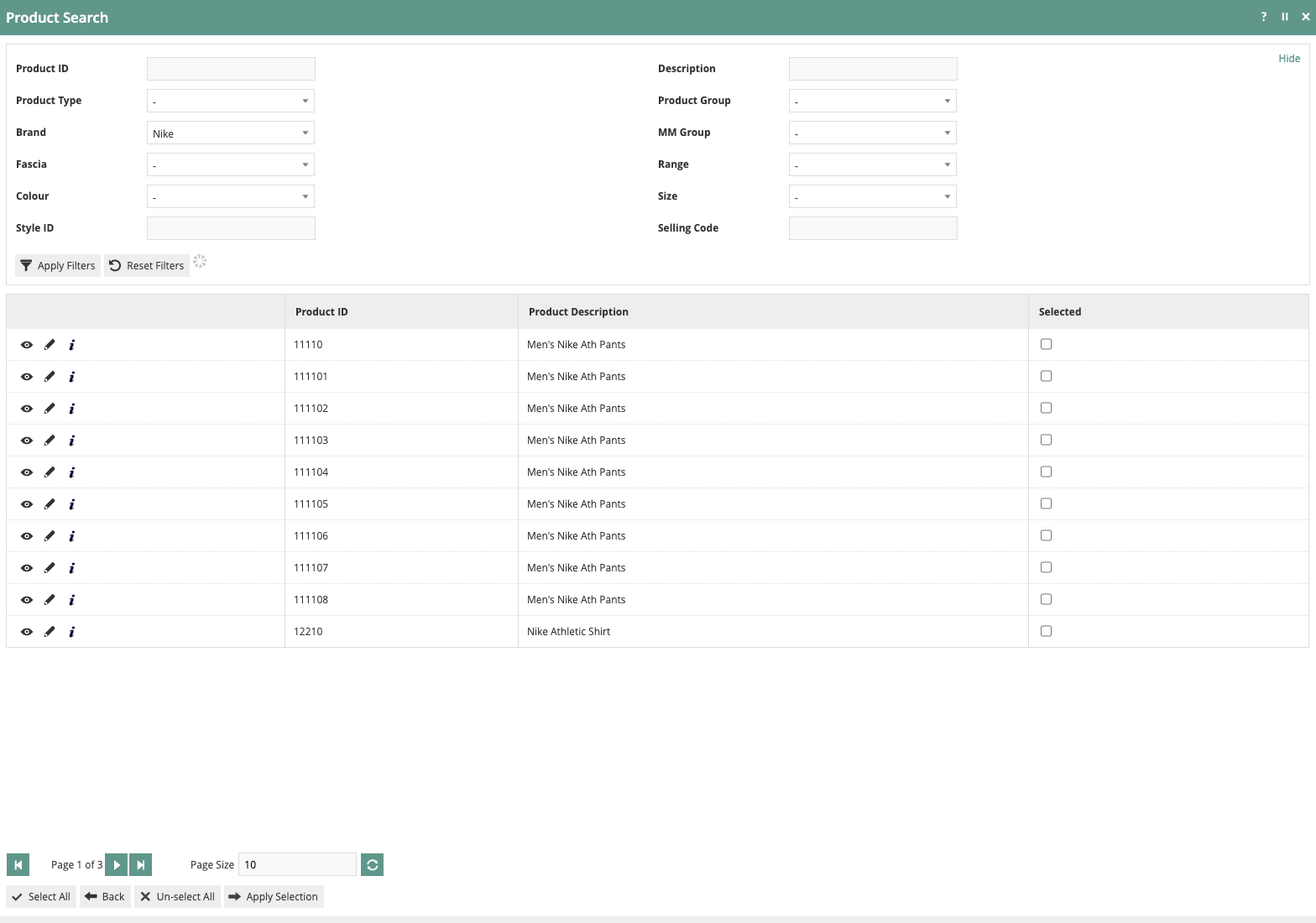
On the Products tab, items can be explicitly Included or Excluded by entering the Product ID and clicking Add Product ID. Multiple products can be added at once using Select Products and the Product Search function:
Brands tab
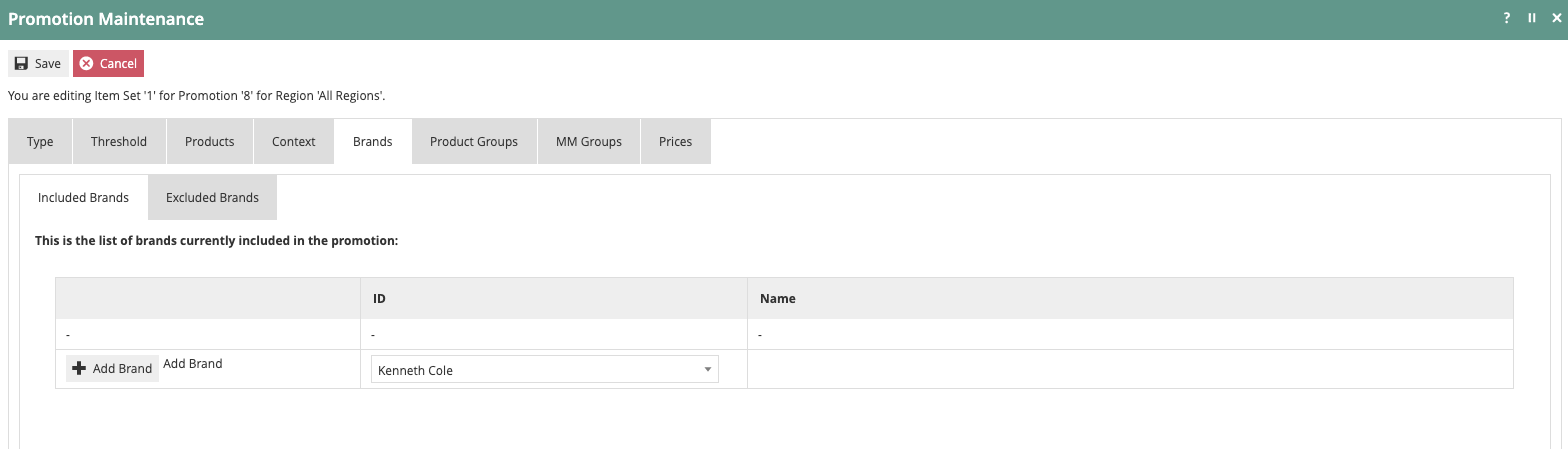
To add a Brand to the Included Brands or Excluded Brands list, select the desired Brand from the dropdown and click Add Brand. Multiple Brands are treated as an OR condition:
Product Groups tab
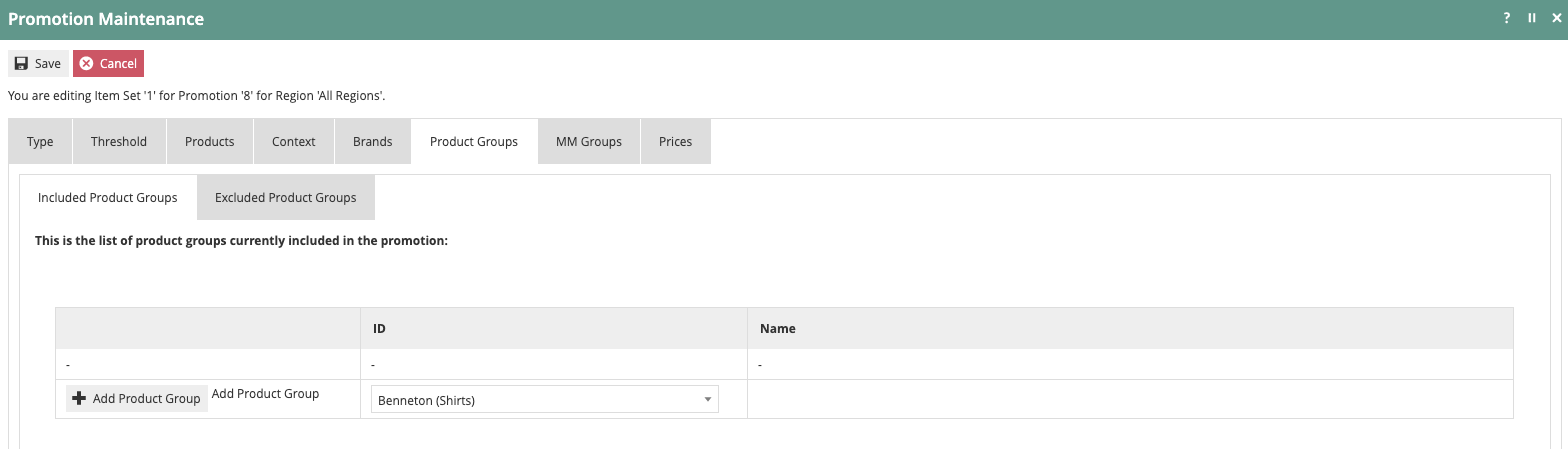
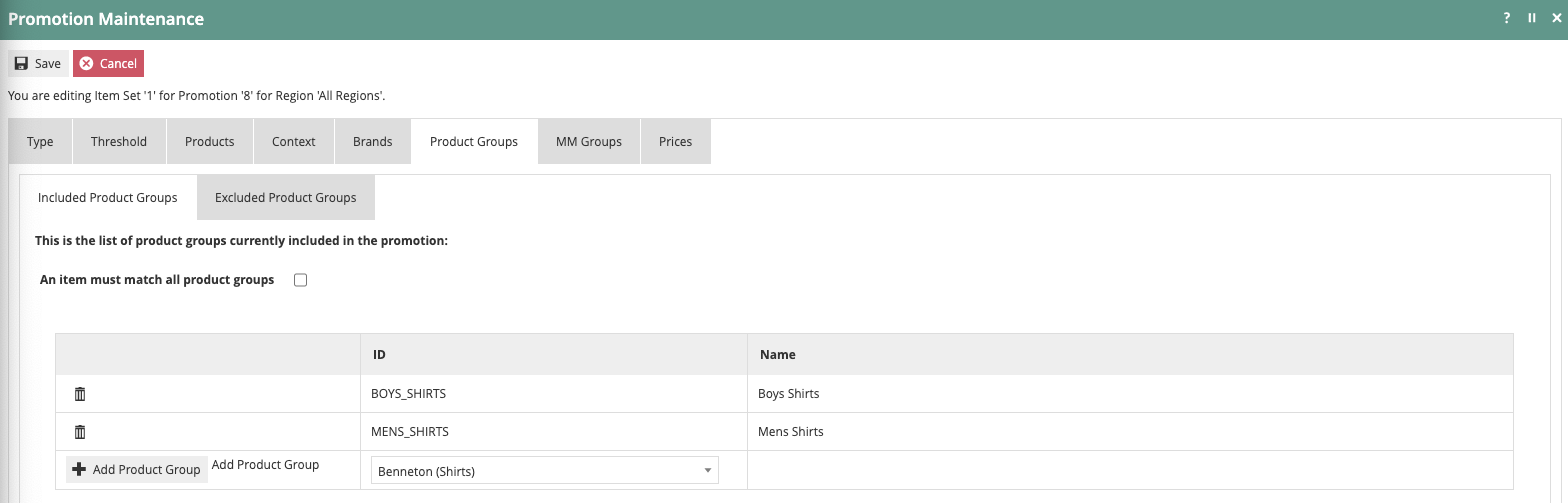
To add a Product Group to the Included Product Groups or Excluded Product Groups list, select the group and click Add Product Group. Multiple Product Groups are treated as an OR condition by default. When multiple groups are listed, the additional option An item must match all product groups becomes available, switching to AND logic:
MM Groups tab
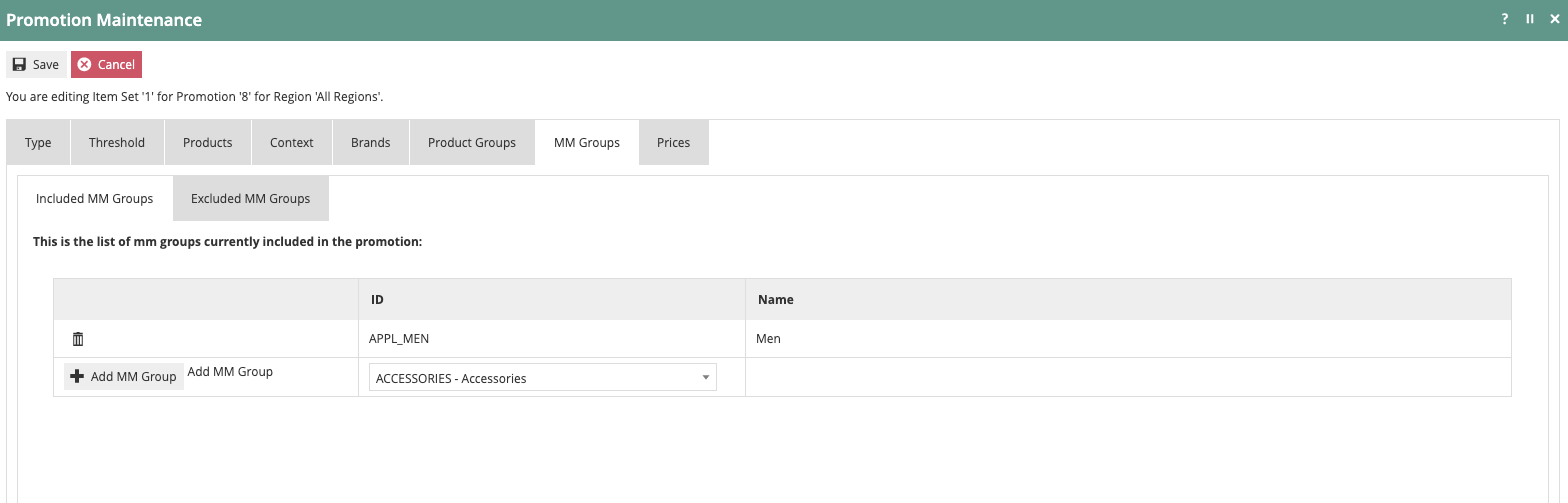
To add an MM Group to the Included MM Groups or Excluded MM Groups list, select the desired MM Group and click Add MM Group. When selecting an MM Group, all sub-groups are automatically included:
Item Set criteria from different tabs can be combined using AND logic. For example, select an MM Group on the Included MM Groups tab to include a category, then exclude a specific Brand on the Excluded Brands tab to remove certain items from that category.
This completes the Item Sets configuration.
Item Set Promotion Types
There are 19 base Item Set Promotion Types. The information required to define the associated Reward varies based on the selected Promotion Type.
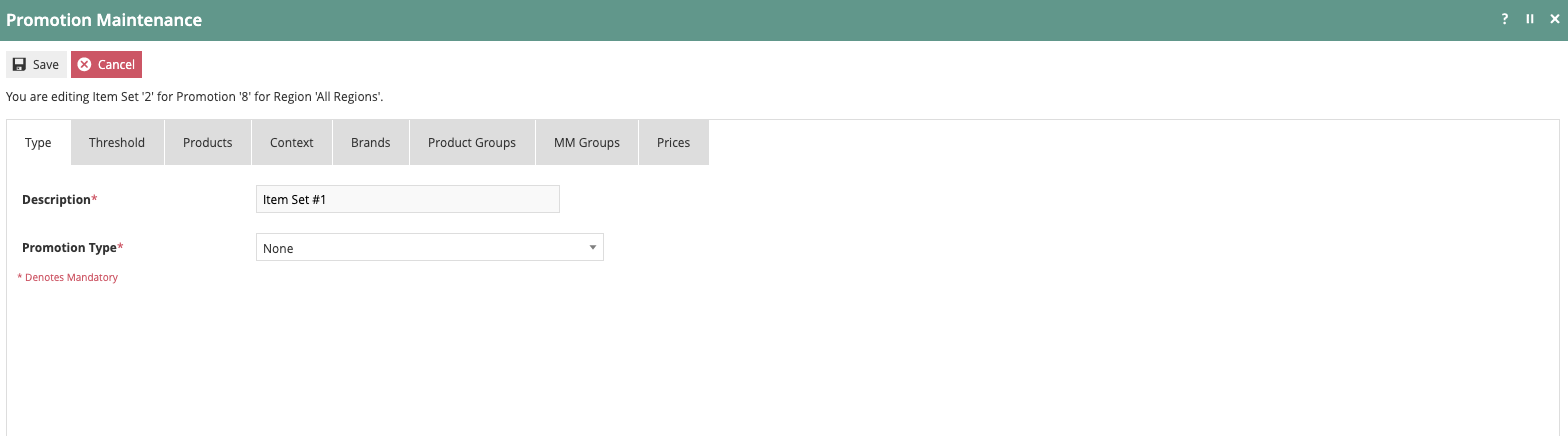
None
Used in Promotions where the qualifying items are different from the items receiving the Reward. For example: 10% off accessories with a Tablet purchase - the Tablet Item Set has Promotion Type None (qualifying only), while the accessories Item Set has % Discount (the Reward):
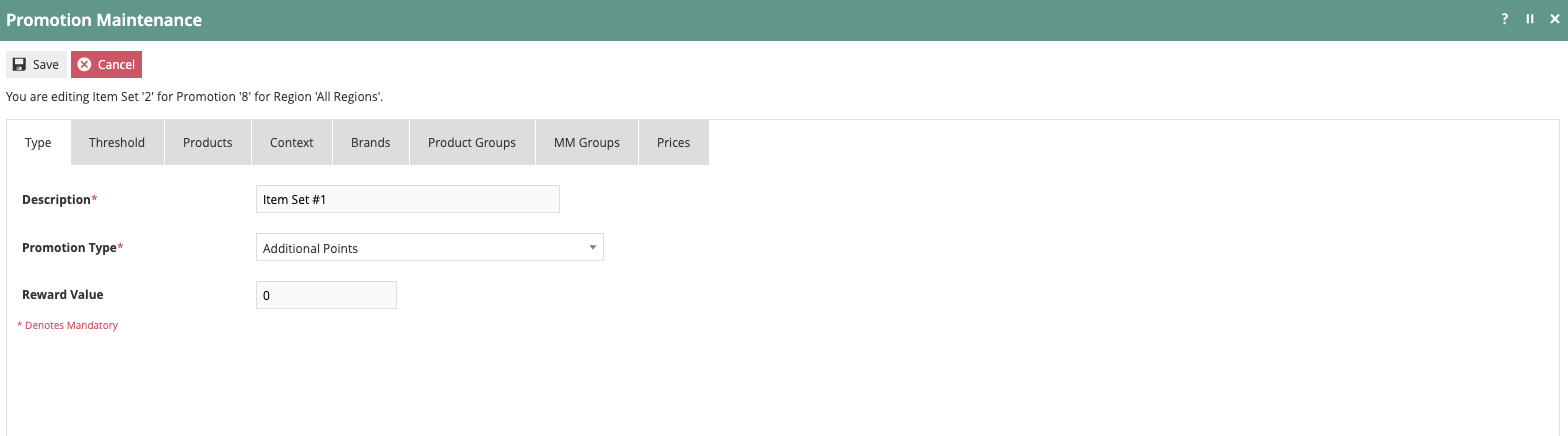
Additional Points
Rewards the customer with Additional Points deposited into their Loyalty account. The Reward Value represents the number of Additional Points:
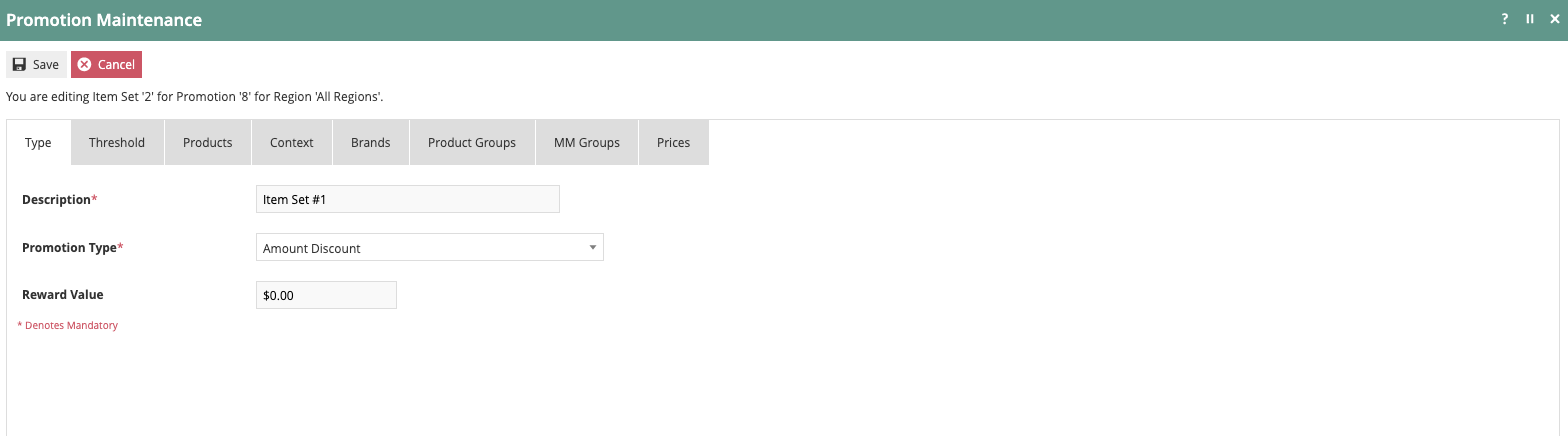
Amount Discount
Rewards the customer with a currency Amount Discount applied singularly to the Item or Group of Items in the Item Set:
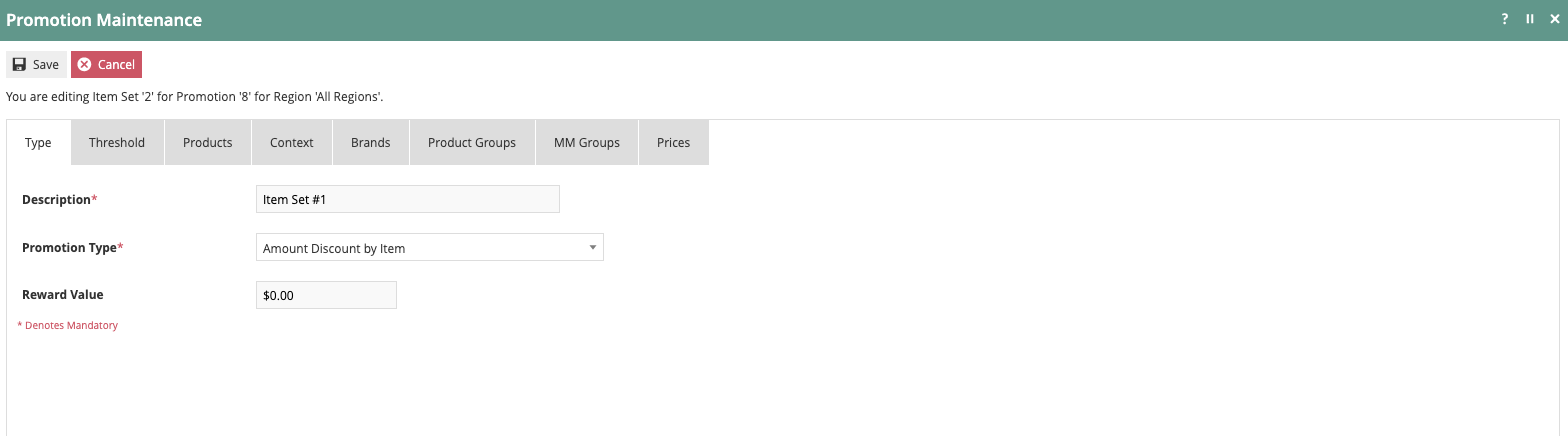
Amount Discount by Item
Rewards the customer with a currency Amount Discount applied to each item in the Item Set:
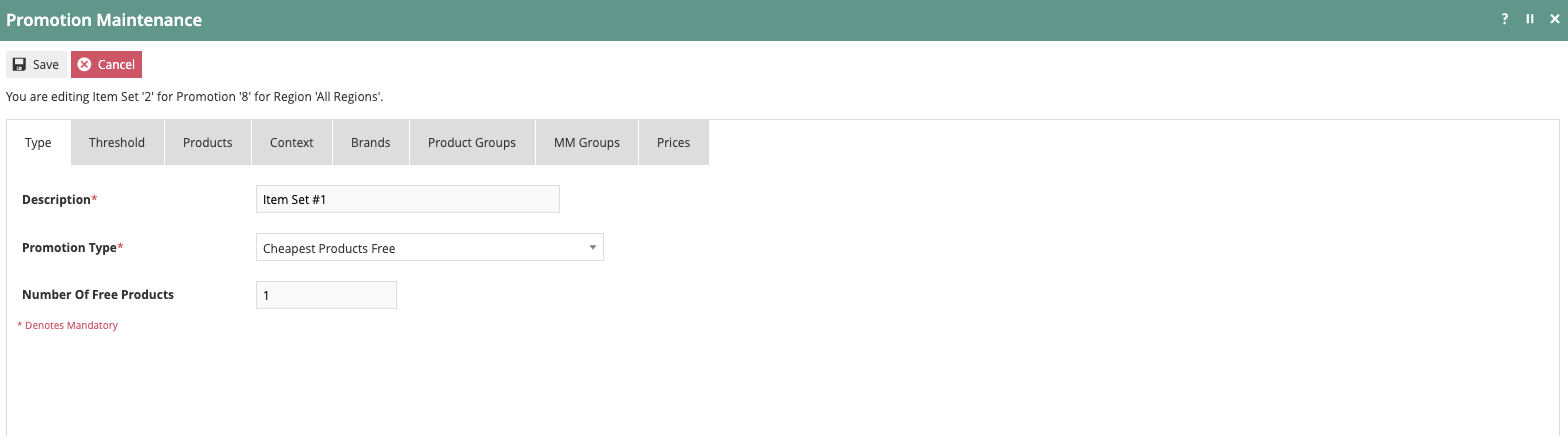
Cheapest/Closest/Dearest Products Free
Rewards the customer by fully discounting a designated number of items in the Item Set (100% discount). The variants - Cheapest, Closest, Dearest - control which item in the group is given free. Specify the Number Of Free Products:
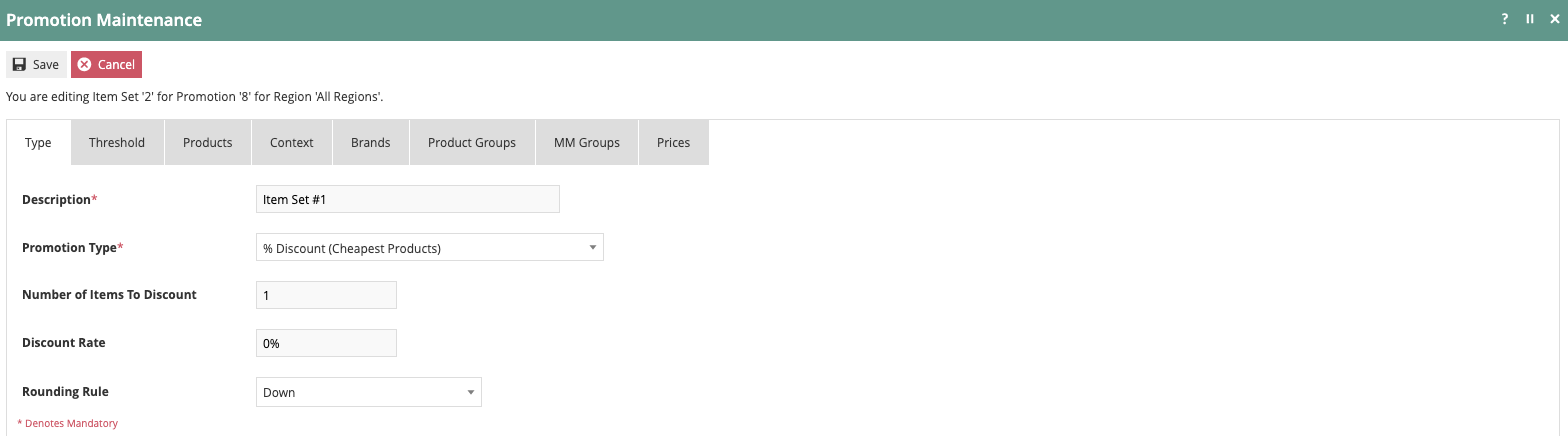
% Discount (Cheapest/Closest/Dearest Products)
Rewards the customer by applying a percentage discount to a designated number of items. Requires the Number of Items to Discount, Discount Rate, and Rounding Rule:
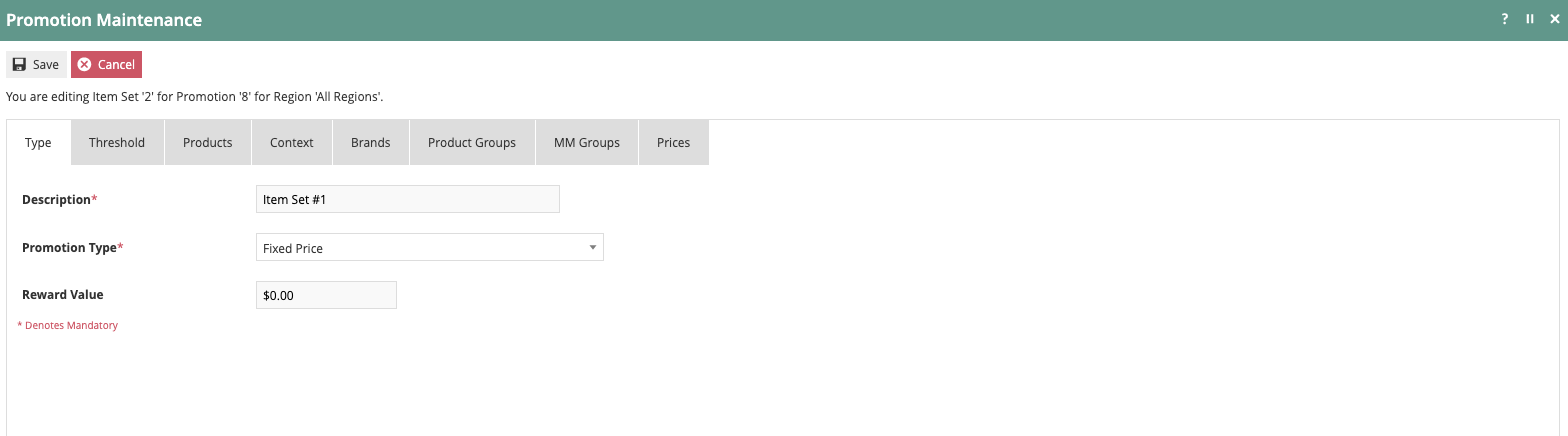
Fixed Price
Rewards the customer by applying a Fixed Price to the group of items defined in the Item Set (e.g., any shirt and tie for £100). The Reward Value is the promotional selling price, not a discount amount:
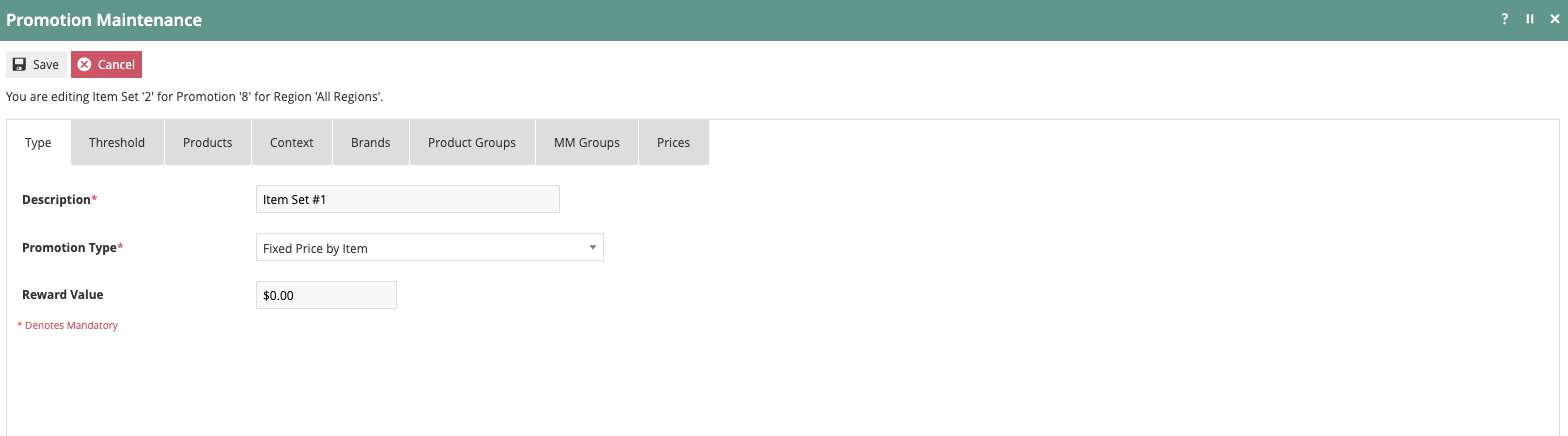
Fixed Price by Item
Similar to Fixed Price, but establishes a promotional selling price for each individual item rather than the bundle. The Reward Value is the promotional price per item:
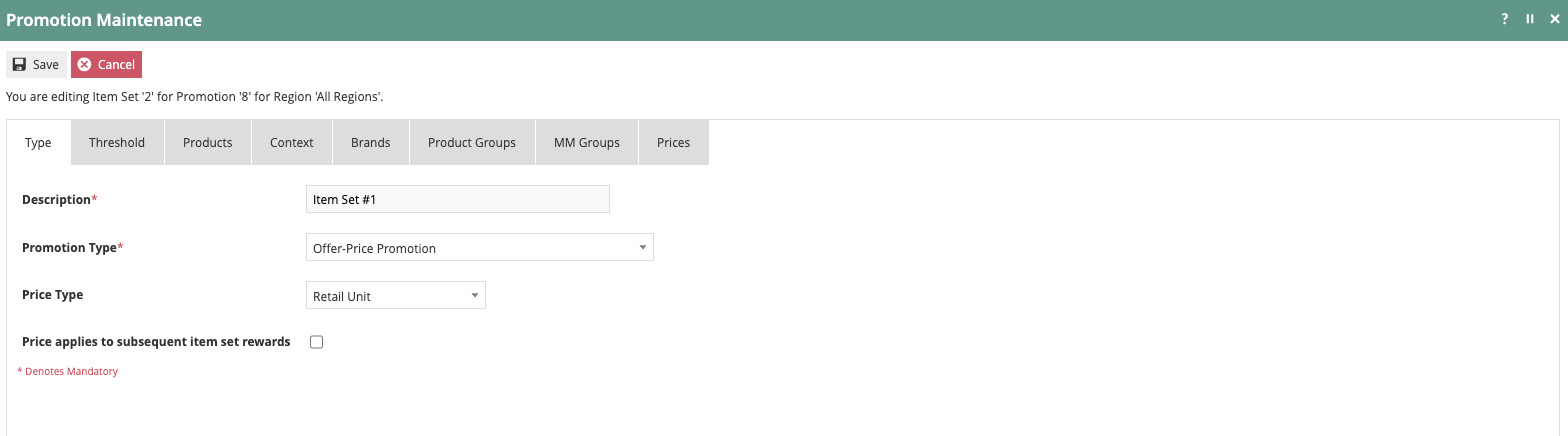
Offer-Price Promotion
Rewards the customer by applying an alternative Price Type for the items defined by the Item Set. Select the Price Type to use for the Promotion:
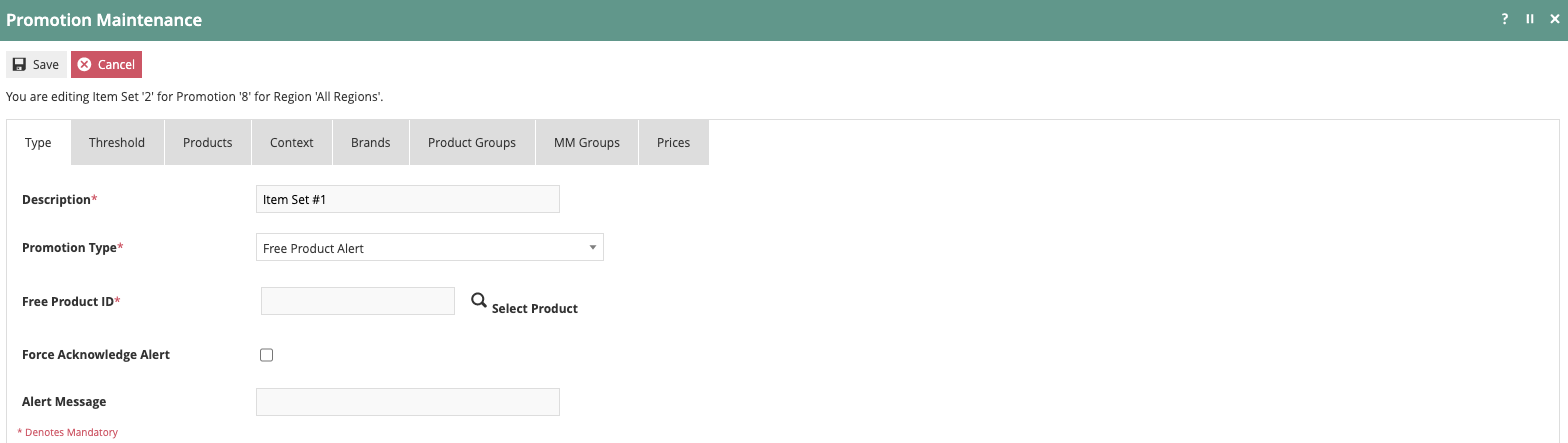
Free Product Alert
Rewards the customer with a Free Product given by the operator upon qualification. Requires entry of the Free Product ID. Optionally, enable Force Acknowledge Alert to require operator acknowledgement and set a custom Alert Message:
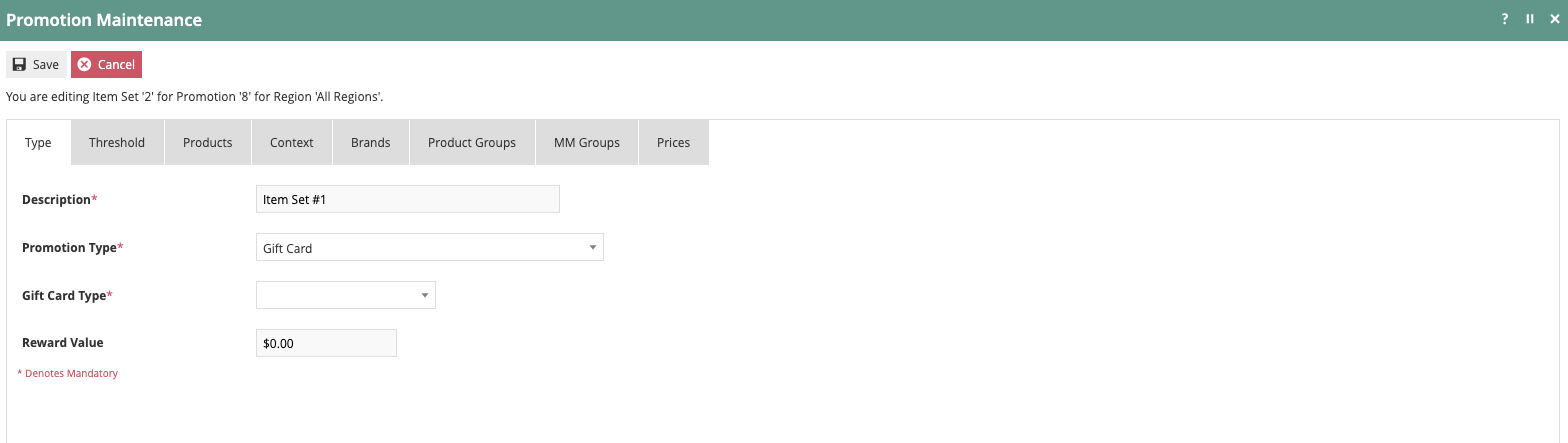
Gift Card
Rewards the customer with a Gift Card activated during the tender process. Select the Gift Card Type and enter the amount in the Reward Value:
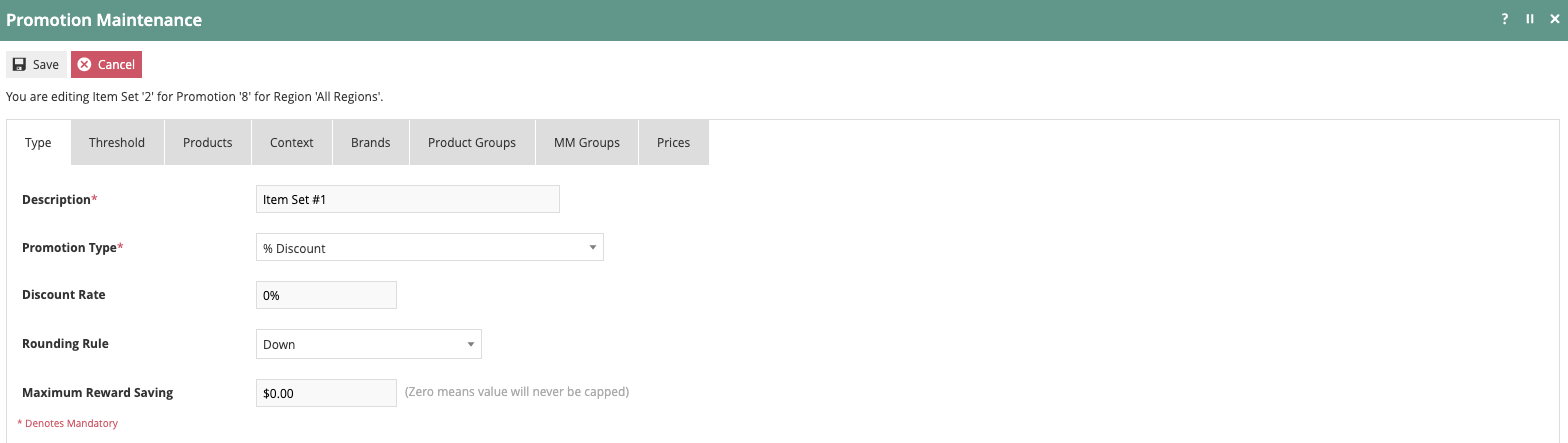
% Discount
Rewards the customer with a Percentage-based Discount on the items defined by the Item Set. The Rounding Rule controls rounding direction. A Maximum Reward Saving can cap the discount:
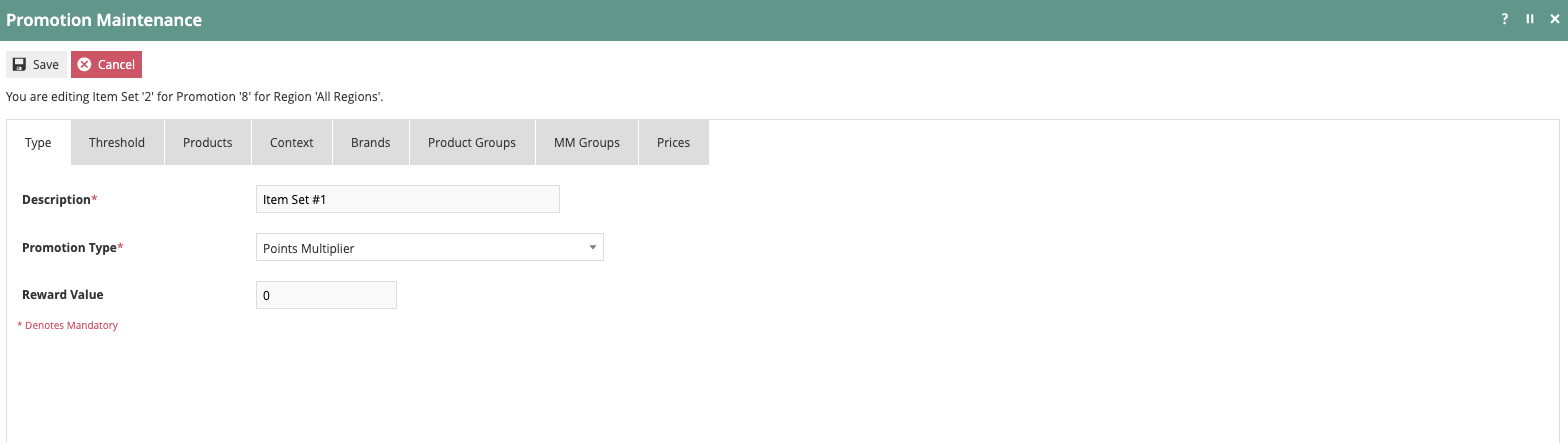
Points Multiplier
Rewards the customer with Additional Points by multiplying the Points earned by items in the Item Set by the Reward Value:
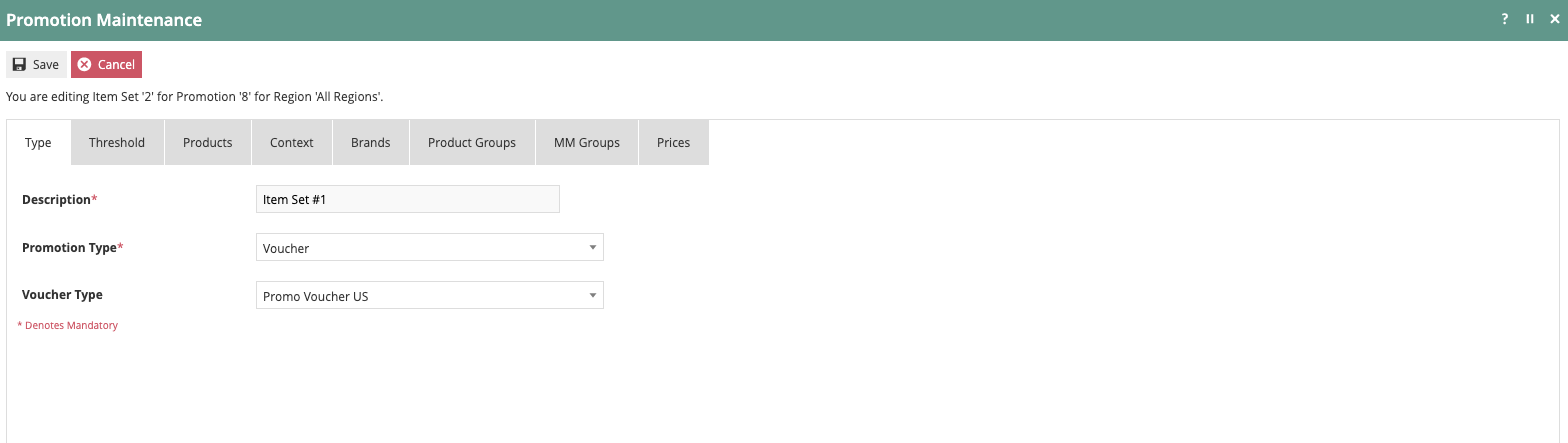
Voucher
Rewards the customer with a Voucher for a future purchase. The Voucher Type is selected from a dropdown containing all Vouchers available within the Promotion's selected Region.
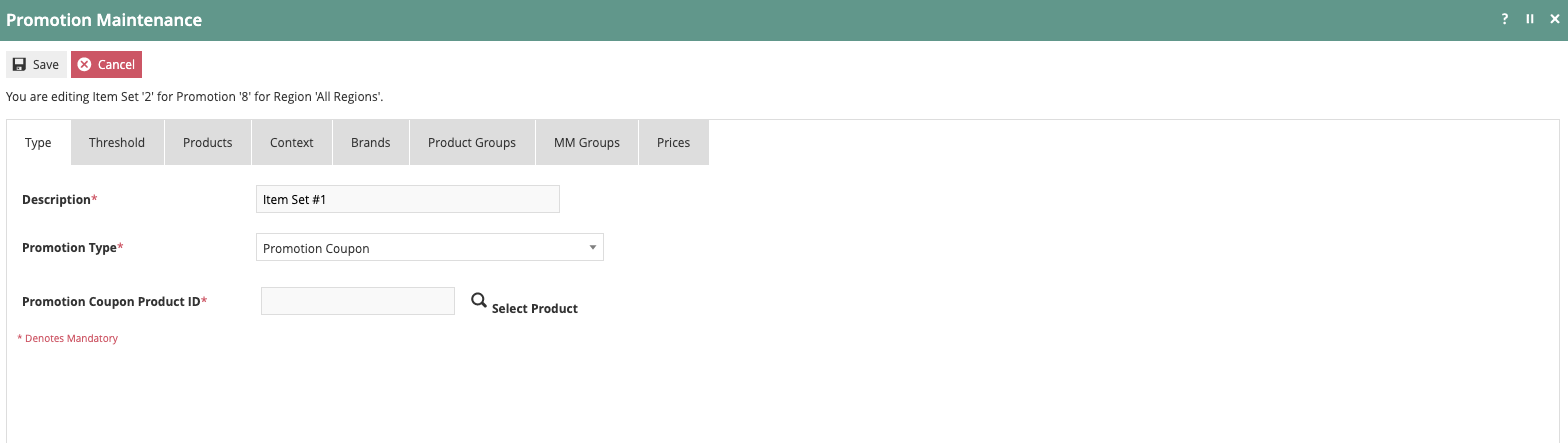
Promotion Coupon
Rewards the customer with a Promotion Coupon for a future purchase. Enter the Coupon Product ID directly or use Select Product and the Product Search application:
A Promotional Coupon Product can be created in Product Maintenance (Product Type: Promotional Coupon Product) and included in an Item Set as a simple coupon mechanism when single-use or serial number tracking is not required.
Spend X Get Free Product
Rewards the customer with a Free Product after meeting a currency spend Threshold within the Item Set. Enter the Free Product ID directly or use Select Product:
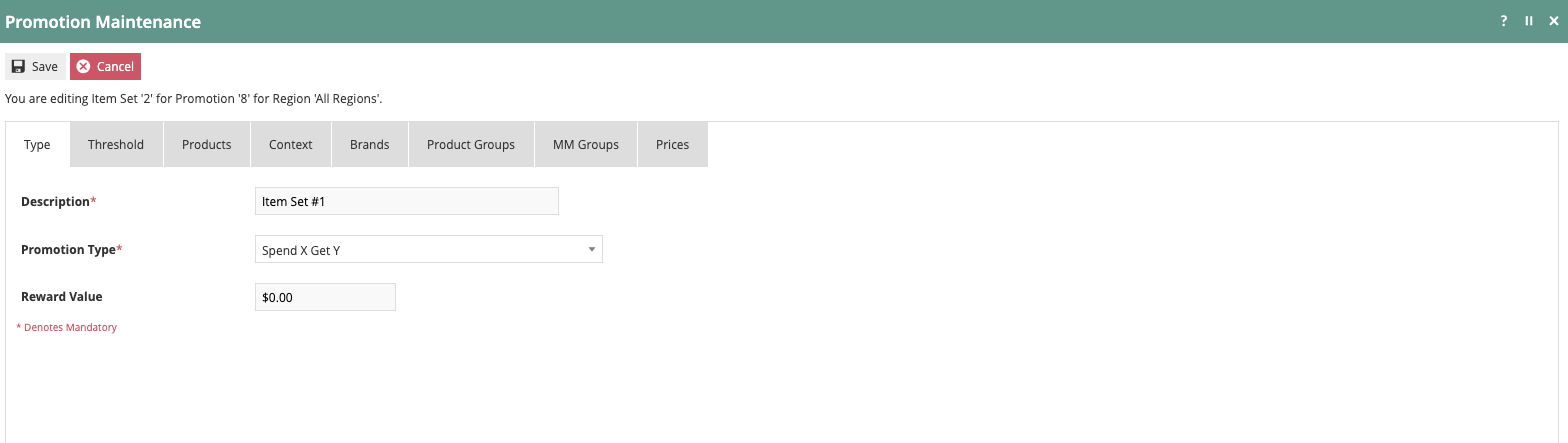
Spend X Get Y
Rewards the customer with a currency Amount Discount applied every time the spend Threshold is met within the Item Set. The Reward Value is the per-threshold discount amount:
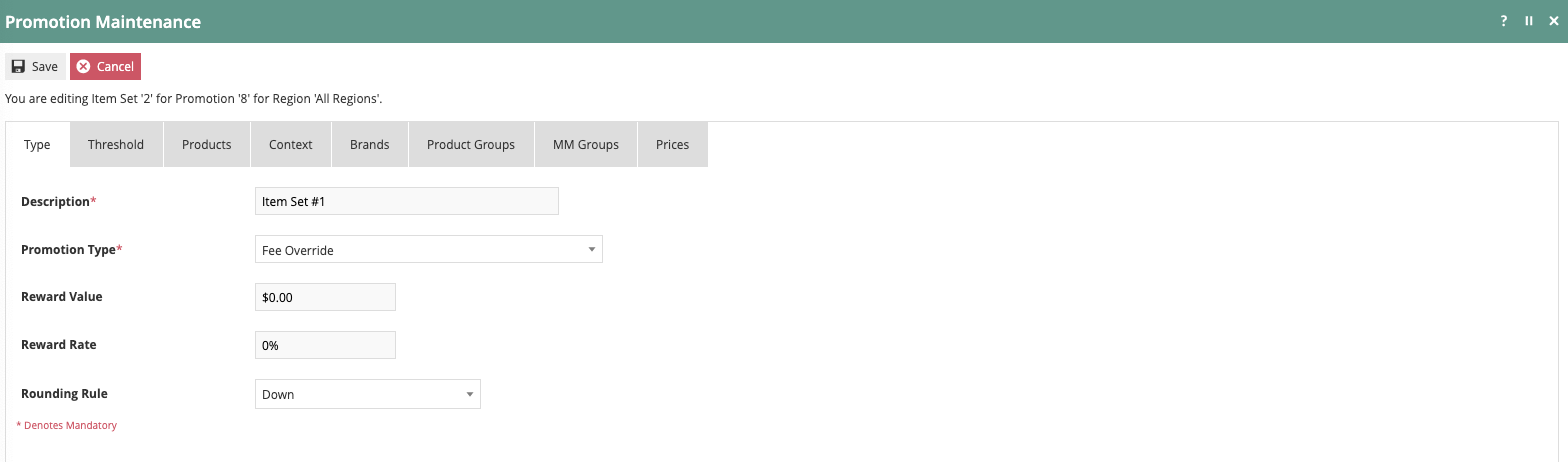
Fee Override
Rewards the customer by applying a promotional fixed selling price or discount percentage to a Fee Product Item (such as shipping, delivery, or installation fees). Enter either a selling price in Reward Value or a discount percentage in Reward Rate with the appropriate Rounding Rule:
This completes the Item Set Promotion Types configuration.
Item Set Threshold Types
All Item Set Promotions use the same form to define the qualification Threshold. Select the Threshold Type from the dropdown and enter the desired Threshold Value:
| Threshold Type | Description |
|---|---|
| Count | The number of items in the Item Set. |
| Value | The monetary value of all items in the Item Set. |
| Points | The number of Loyalty Points earned by items in the Item Set. |
If the Promotion is configured to Alert Operator When Nearly Triggered, an additional Alert Threshold field is displayed:
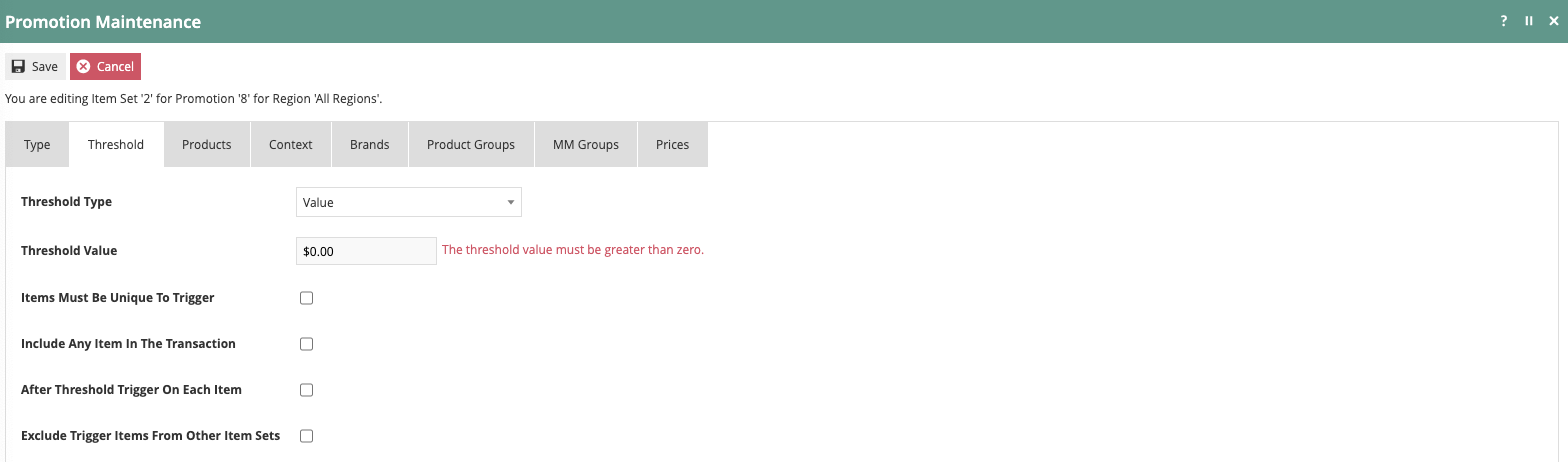
The following additional options are available on the Threshold tab:
| Option | Description |
|---|---|
| Items Must Be Unique To Trigger | A specific product can only be used once for qualification, regardless of how many times it appears in the transaction. |
| Include Any Item In The Transaction | Moves all products into an Include state. Removes the Include tabs from Products, Brands, Product Groups, and MM Groups - Excludes can still be specified. |
| After Threshold Trigger On Each Item | The reward continues to trigger for each additional item after the threshold has been met. For example, a 10% discount at 3+ shirts would also apply to a 4th shirt. |
| Exclude Trigger Items From Other Item Sets | Prevents a single item from being used to satisfy the threshold in multiple Item Sets. |
This completes the Item Set Threshold Types configuration.
Broadcasting
After configuring Promotions in the Estate Manager, the changes must be broadcast to POS devices for them to take effect.
Broadcast the following entity after creating or modifying Promotions:
- Promotion
Broadcasts are covered in detail in the Broadcasting How-To Guide.
About This Document
©2026 Enactor Ltd
All documents produced by Enactor Ltd are supplied to Customers subject to Copyright, commercial confidentiality and contractual agreements and must not be copied or transferred without permission.
Document Context
This document is part of the Enactor Product Documentation Series. All Enactor products include a comprehensive documentation set designed to improve understanding of the product and facilitate ease of use.
Document Inquiries
At Enactor we aspire to producing the highest quality documentation to reflect and enhance the quality of our Product. If you find that the document is inaccurate or deficient in any way, please assist us in improving our standard by letting us know.
For matters of document quality or any other enquiries regarding this document, please contact:
By Email: documentation@enactor.co.uk
Document History
The following versions of this document have been produced:
| Version | Status | Issue Date | Author | Reason for Issue |
|---|---|---|---|---|
| 1.0 | Initial Draft | 11 Jan 2021 | Michael Tolson | Initial version. |
| 2.0 | Updated | 2026-02-28 | Mark Harrison | Reformatted to Docusaurus format; screenshots updated. |